Christmas MT's answer to LockB's Secondary 3 A Maths Singapore question.
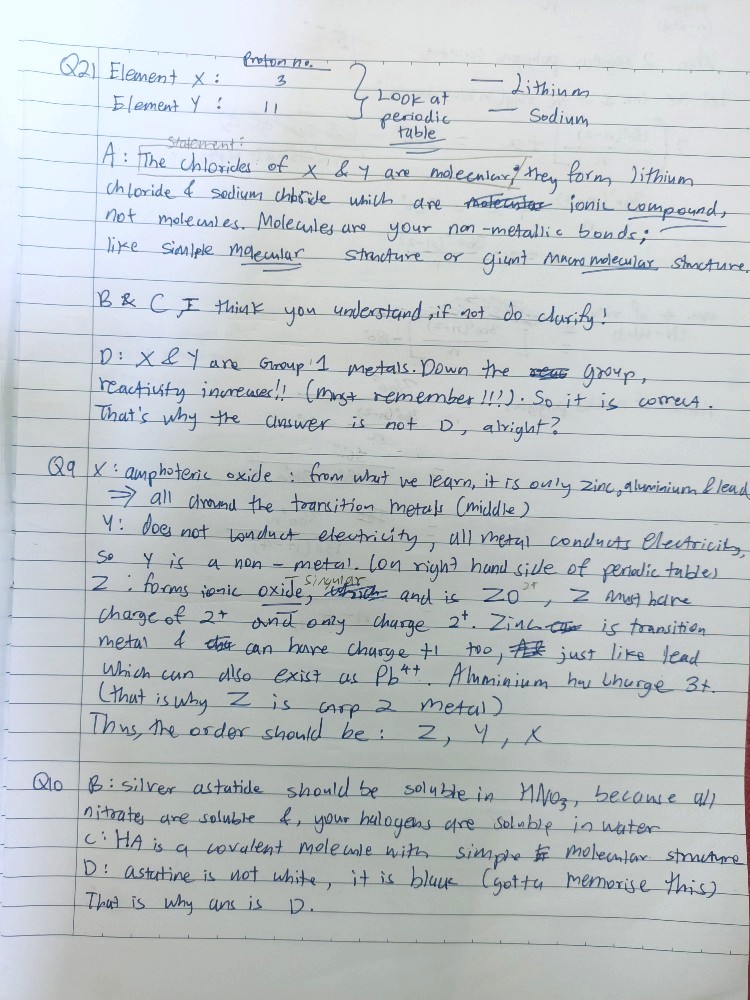
done
{{ upvoteCount }} Upvotes
clear
{{ downvoteCount * -1 }} Downvotes

Hope it helps. Do clarify if uncertain about anything.
Date Posted:
5 years ago

for qn21, anything that mentions "reactive" it will be increase/decrease down the group according to periodic table no matter what? this qn mentioned water hence i was confused...
for qn10, i still dont really understand B... i also dont understand option A although i cancelled it
Grp 7 halogens can undergo displacement reaction. Reactivity decreases down the group. So the more reactive halogen can displace the less reactive halide. E.g if you add Fl (element,halogen) to lets say HCl (Cl- ion, halide), because Fl is more reactive, Cl will be displaced. So thats why bromine, more reactive halogen can displace astatine from its halide. That is why A is correct. As for B, Nitric acid (even concentrated) is essentially an aqeuous solution. Effectively, silver halides will not dissolve in water. This is just something that needa remember. (silver and lead chlorides,iodides are insoluble, applicable for the whole grp 7). If anything else need to be clarified do ask :))

 360 Tutoring Program