Eric Nicholas K's answer to LockB's Secondary 3 A Maths Singapore question.
done
{{ upvoteCount }} Upvotes
clear
{{ downvoteCount * -1 }} Downvotes

Q17
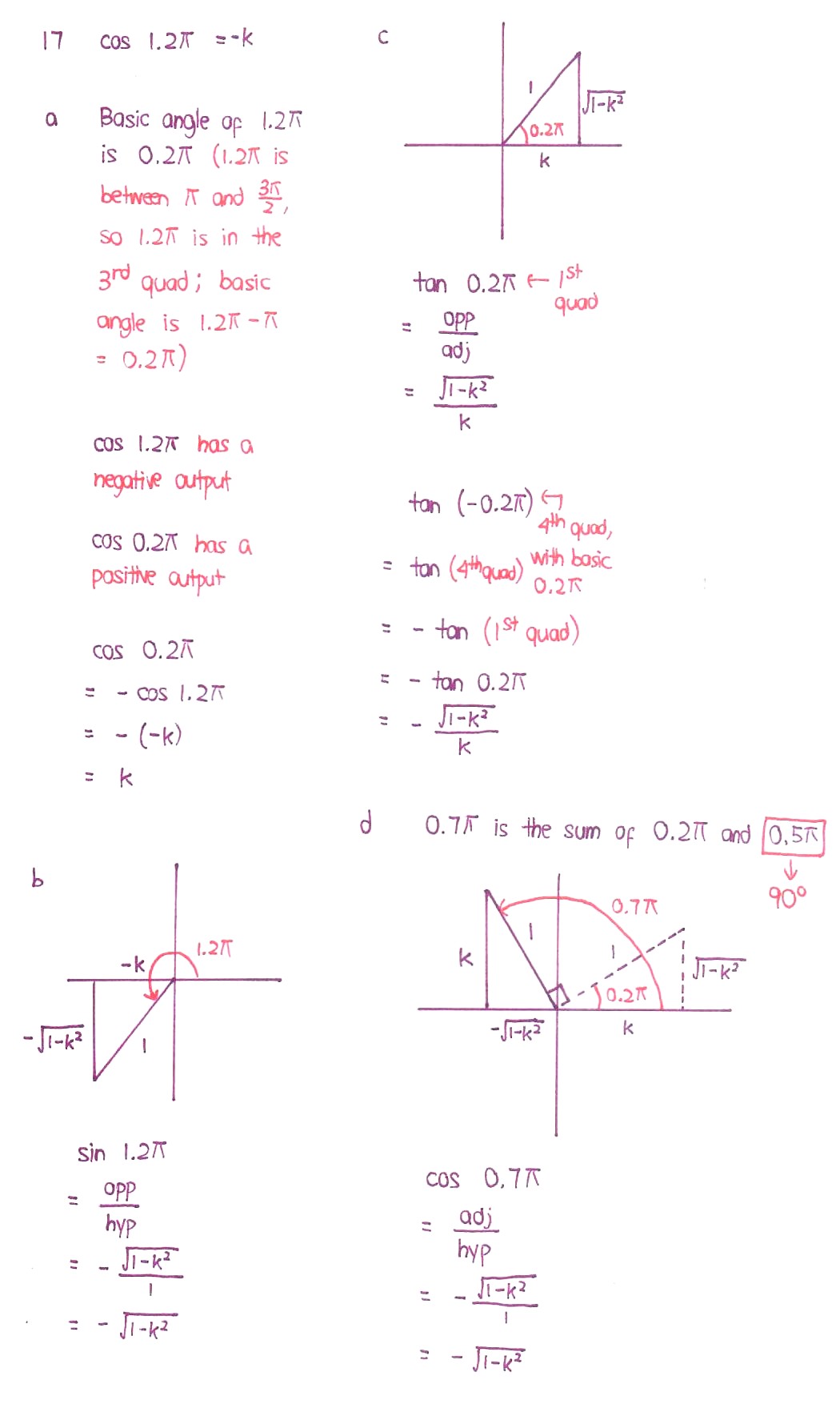
The fourth part is very hard for me to explain in regular terms, and I am not sure if this should even be asked at this juncture (once you learn about the addition angle formulae at a later part of trigo, part d should be doable without doing a further diagram like I did there).
The fourth part is very hard for me to explain in regular terms, and I am not sure if this should even be asked at this juncture (once you learn about the addition angle formulae at a later part of trigo, part d should be doable without doing a further diagram like I did there).
Date Posted:
6 years ago

how does decimal pi work tho, i have no idea about how it works as it is my first time seeing it hence i don't know how to start/do this qn
Every pi/2 radians is equivalent to 90 degrees. Every pi radians is equivalent to 180 degrees.
By inspection, 1.2pi radians is actually equal to 216 degrees. This compares to 0.2pi radian which is actually equal to 36 degrees.
And we know that 216 is an angle whose basic angle is 36.
It’s all the same idea as the degree version, but it does take time to adapt to the radian version of the angle.
i dont really understand part a and c tho
(also dont really understand part d but i saw what you typed so i guess its ok)
(also dont really understand part d but i saw what you typed so i guess its ok)
btw you can explain whenever you are free to do so, as you are not free today
For part a, you need to realise that 1.2pi is an angle in the third quadrant.
If you have converted 1.2pi to degrees, you will get 216 deg.
In other words, they told you that cos 216 = -k. We need to find out the value of cos 0.2pi, or cos 36.
In other words, we need to obtain the value of cos 36, given that cos 216 is -k.
We soon realise that 216 is an angle in the third quadrant, with basic angle 36. This means that the triangles for 36 and 216 are identical in numbers, but not in signages.
Clearly a cosine in the third quadrant and a cosine in the first quadrant, with the same basic angles, will have different signages but otherwise the same numerical values.
So, if cos 216 = -k, then cos 36 = k.
So, if cos 1.2pi = -k, then cos 0.2pi = k.
Again, for part c, we need to make references as usual.
But first, before calculating tan (-0.2pi), we first need to have tan 0.2pi ready. So, what is tan 0.2pi?
We previously obtained cos 0.2pi as k. To obtain the value of tan 0.2pi, you will need to draw the quadrants triangle for 0.2pi (first quadrant). Since cos 0.2pi = k, we set the hypotenuse as 1 and the adjacent side as k. The opposite length would then be sqrt (1 - k^2).
Then, from there, we find that tan 0,2pi = [sqrt (1 - k^2)] / k.
Since -0.2pi is an angle in the fourth quadrant with basic angle 0.2pi, it follows that tan -0.2pi (tan in the fourth quadrant) will have a negative value. Compare this with tan 0.2pi which clearly has a positive value.
So, tan (-0.2pi)
= - tan 0.2pi
= - [sqrt (1 - k^2)] / k
Alternatively, you can draw the quadrants triangle for -0.2k directly, if that would be easier for you.
Part d is actually not supposed to be asked at this juncture. The problem with this is how to draw the quadrants triangle.
To understand this, your concept of coordinate geometry has to be very strong, especially for the section involving perpendicular lines.
If a line connecting (0, 0) and (3, 1) is rotated 90 degrees anticlockwise about the pivoting point (0, 0) for example, how will the new position of the line be like?
If you have done this correctly, you will see that (0, 0) remains put, but the point (3, 1) will go to (-1. 3). This is reflective of the fact that the gradients of two perpendicular lines is equal to -1 (or perhaps it's the other way round).
Initially, the x-distance from (0, 0) to (3, 1) is 3 units long, while the y-distance from (0, 0) to (3, 1) is 1 unit long. After rotation, the positions are swapped - that is, the x-distance is now 1 unit long while the y-distance is now 3 units long. Any line rotated 90 degrees in this manner will have their x-movements and y-movements swapped. Of course, the x-movement is -1 rather than +1, which is rather clear here.
For this question in part d, the idea is likewise similar. The lengths k and sqrt (1 - k^2) will get swapped in their identities. The new k will become the vertical length while the new sqrt (1 - k^2) will become the vertical length. The negative sign attached to sqrt (1 - k^2) is indicative that the horizontal length is now on the negative side to the left of the y-axis.
Clearly the hypotenuse remains 1 because the length of a line is not affected by any rotation.

 360 Tutoring Program