Eric Nicholas K's answer to LockB's Secondary 3 A Maths Singapore question.
done
{{ upvoteCount }} Upvotes
clear
{{ downvoteCount * -1 }} Downvotes

Q10b
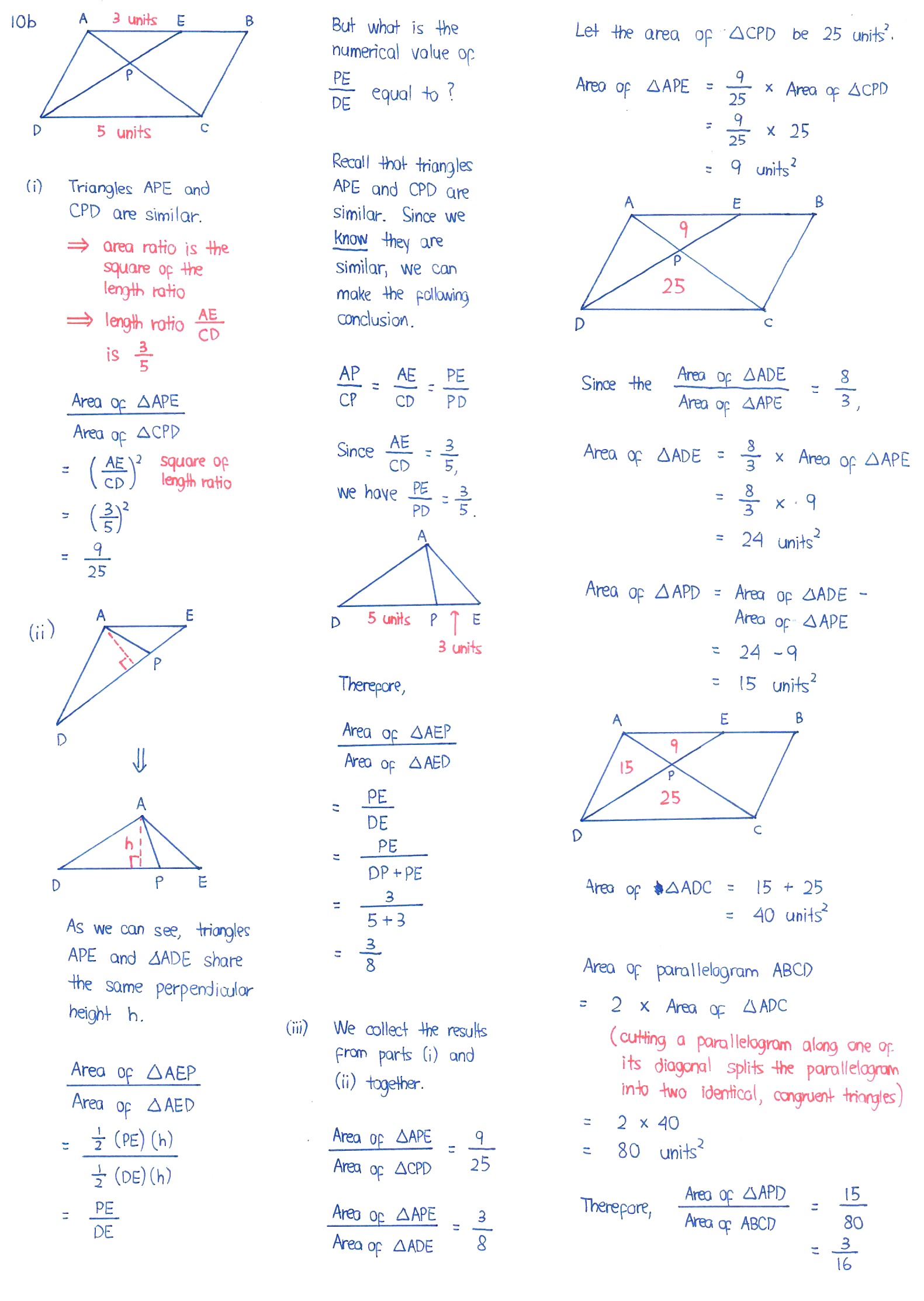
With diagrams included this time; you will need to be able to visualise the diagram without the aid of a diagram in the future (because time will be taken in drawing diagrams in an examination). For now, try and understand how I make the conclusions for the areas.
I have rotated one of the triangles to show you how a triangle can have the same perpendicular height but different bases.
So remember, ask yourself these two questions when you come to these questions:
1. Are the triangles similar?
2. Are the triangles not similar, but possessing the same height (or the same base)?
If the triangles are similar, then the ratio of the areas is the square of the ratio of any corresponding sides of their lengths.
If the triangles have the same height, then the ratio of the areas is the ratio of their bases, since their heights are common and will therefore not affect the ratio of the areas in any way.
Date Posted:
6 years ago

for the part "let the area of triangle CPD be 25units^2"
can we choose any triangle to be our main one to solve the question and still get the same answer at the end? or is there a reason to choose a particular triangle as the main one
can we choose any triangle to be our main one to solve the question and still get the same answer at the end? or is there a reason to choose a particular triangle as the main one
I used CPD = 25 units2 because that number CPD in my fractions appear large.
Of course, you can start from any triangle, and you will still get the same final answer.
Or, you can even choose CPD = 1 unit2, but I do not like seeing fractional units later on (if you recall your time in primary school, a lot of students do not like "fractional" number of units).
Hence, I chose CPD = 25 units2.
In the actual exams, you are probably going to see a bunch of these triangles. Therefore, you should be able to quickly identify pairs of similar triangles and pairs of triangles having the same common heights (do not spend time on other triangles with no common quantity as this will complicate matters later on).
Once you identify the triangles, you should break them up into individual triangles like I did, but then again, you should do so mentally or sketch a quick diagram out.
Because in the exams, these type of area ratio questions are each worth only 1 mark, or if you are more fortunate (or unfortunate depending on how you view it), 2 marks.

 360 Tutoring Program