Eric Nicholas K's answer to girl's Secondary 4 A Maths Singapore question.
done
{{ upvoteCount }} Upvotes
clear
{{ downvoteCount * -1 }} Downvotes

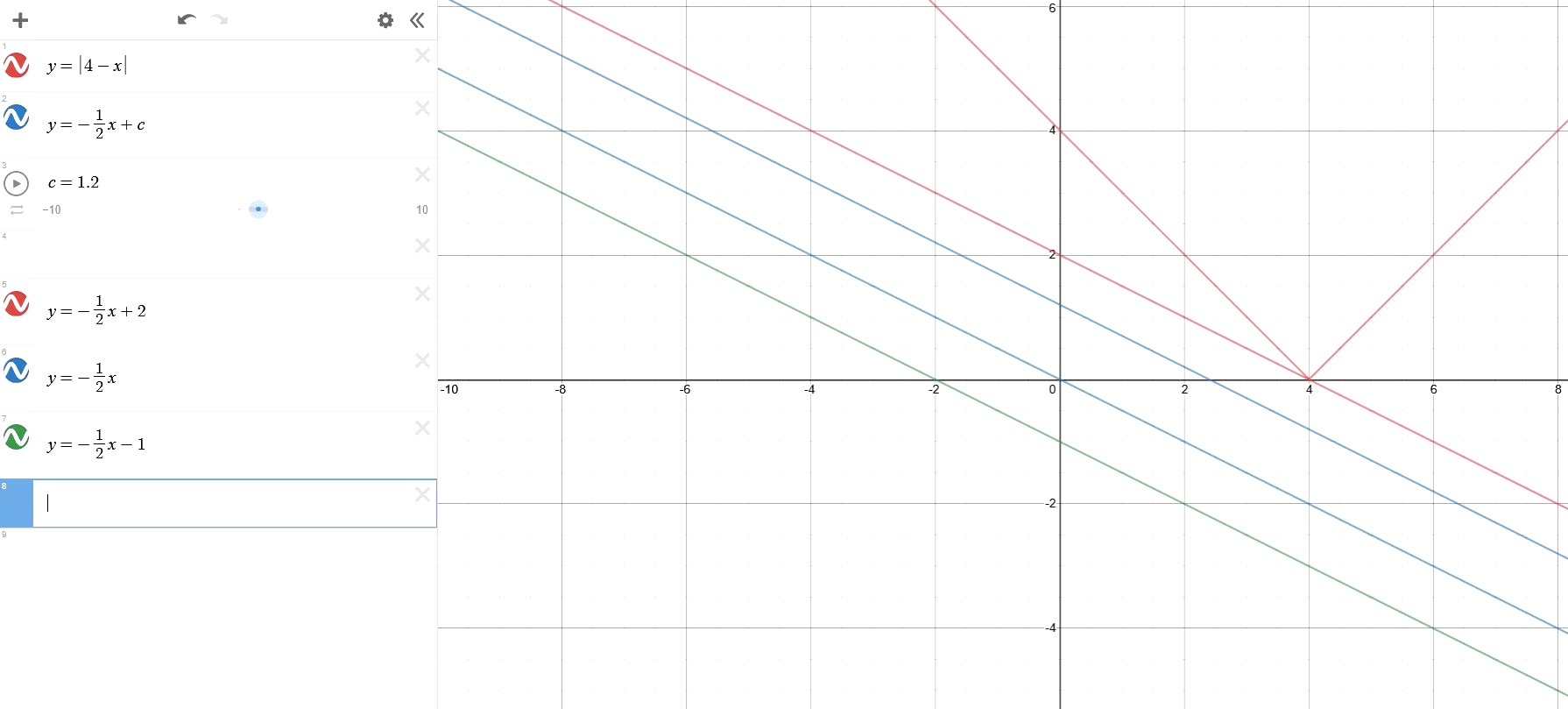
I have included the relevant lines. One of which the c is 2, and the other three have values of c less than 2.
Clearly for c < 2, the line does not intersect the curve, whereas for c = 2, the line intersects the curve at the vertex point (4, 0).
Clearly for c < 2, the line does not intersect the curve, whereas for c = 2, the line intersects the curve at the vertex point (4, 0).
Date Posted:
6 years ago

Im looking at the graph plot. Thank you for the help.

You'll have to justify your answer :
(as stated in the question)
If m = -½, y = -½x + c
For them to intersect, we equate the two graphs.
-½x + c = |4 - x|
4 - x = -½x + c OR 4 - x = -(-½x + c)
½x = 4 - c OR 4 - x = ½x - c
x = 8 - 2c OR 3/2 x = 4 + c →x = 8/3 + ⅔c
Then
y = -½(8 - 2c) + c OR y = -½(8/3 + ⅔c) + c
y = 2c - 4 OR y = ⅔c - 4/3
Now if c < 2,
2c < 4 OR ⅔c < 4/3
2c - 4 < 0 OR ⅔c - 4/3 < 0
This means y < 0.
But y ≥ 0 for the graph of y = |4 - x|since the graph only touches the x-axis at one point (4,0) and the rest of it is above the axis.
So there are no points of intersection
Probably the justification is a graphical justification, because algebraic approaches seem too long for a 2 mark question
For a graphical justification in iii), the student must have already in mind that when c = 2, the graph will intersect y = |4 - x| at only one point.
So he/she will still have to solve -½x + 2 = |4 - x| algebraically by setting c = 2.
Then, the graph needs to be drawn to show no intersection for c < 2. So it is a mixture of both graphical and algebraic here.
The problem is most students will be stuck on how to even start. Many wouldn't think of trying to set c = 2 and then realising the single point of intersection.
It is good to learn the fully algebraic method nevertheless.
For a), a qualitative justification can be made by reasoning based on the slope of y = mx + c when m = 1.
The slopes are the same for y = x + c and the portion on the modulus graph where y = x - 4.
So they are parallel and would never intersect unless when c = -4 (whereby they are coincident)
But since c > 2 implies c > -4, so they will not be coincident.
So the graph y = mx + c only intersects the portion y = 4 - x , and at at 1 point since both are linear and are not parallel.
For b),
when m = ½, c = 0, y = ½x
It is not parallel to either portions and could intersect at 2, 1 or no points.
Keeping m = ½,
y = ½x + c
To intersect at 1 point (4,0) where the slope of y = |4 - x| changes,
0 = ½(4) + c
c = -2
When c < -2, there is no intersection.
But since c = 0 > -2, the graphs will intersect at 2 points (show by drawing graph)
Fully algebraic method :
½x = |4 - x|
4 - x = ½x or 4 - x = -½x
3/2 x = 4 or ½x = 4
x = 8/3 or x = 8
y = ½(8/3) or y = ½(8)
y = 4/3 or y = 4
Two points of intersection.
The algebraic method is easier here than having to come up with a qualitative + graphical method.
Thanks guys

 360 Tutoring Program