Ask Singapore Homework?
Upload a photo of a Singapore homework and someone will email you the solution for free.


Question
secondary 4 | A Maths
One Answer Below
Anyone can contribute an answer, even non-tutors.

How do you solve part (iii)?
Date Posted: 6 years ago
Views: 270

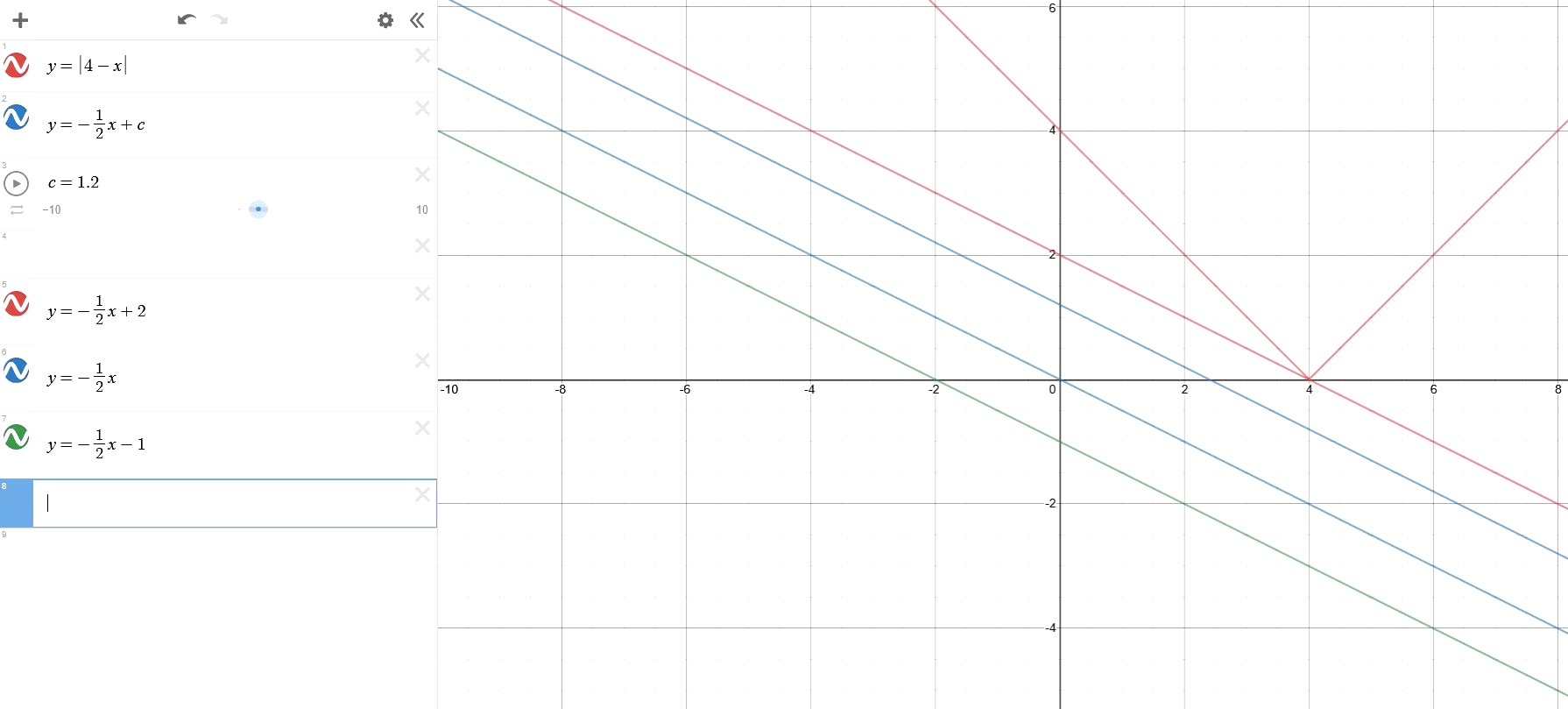
Girl, for this we must first draw out the line with m = -1/2 and c = 2, or in other words,
y = -0.5x + 2
I'm very certain this line will intersect the modulus curve at the vertex point (4, 0).
Shift the line down and there will be no intersection, since the line is not as steep as the downsloping part of the modulus curve.
I will do a demo on Desmos.
y = -0.5x + 2
I'm very certain this line will intersect the modulus curve at the vertex point (4, 0).
Shift the line down and there will be no intersection, since the line is not as steep as the downsloping part of the modulus curve.
I will do a demo on Desmos.
See 1 Answer
done
{{ upvoteCount }} Upvotes
clear
{{ downvoteCount * -1 }} Downvotes
I have included the relevant lines. One of which the c is 2, and the other three have values of c less than 2.
Clearly for c < 2, the line does not intersect the curve, whereas for c = 2, the line intersects the curve at the vertex point (4, 0).
Clearly for c < 2, the line does not intersect the curve, whereas for c = 2, the line intersects the curve at the vertex point (4, 0).
Date Posted:
6 years ago
Im looking at the graph plot. Thank you for the help.

You'll have to justify your answer :
(as stated in the question)
If m = -½, y = -½x + c
For them to intersect, we equate the two graphs.
-½x + c = |4 - x|
4 - x = -½x + c OR 4 - x = -(-½x + c)
½x = 4 - c OR 4 - x = ½x - c
x = 8 - 2c OR 3/2 x = 4 + c →x = 8/3 + ⅔c
Then
y = -½(8 - 2c) + c OR y = -½(8/3 + ⅔c) + c
y = 2c - 4 OR y = ⅔c - 4/3
Now if c < 2,
2c < 4 OR ⅔c < 4/3
2c - 4 < 0 OR ⅔c - 4/3 < 0
This means y < 0.
But y ≥ 0 for the graph of y = |4 - x|since the graph only touches the x-axis at one point (4,0) and the rest of it is above the axis.
So there are no points of intersection
Probably the justification is a graphical justification, because algebraic approaches seem too long for a 2 mark question
For a graphical justification in iii), the student must have already in mind that when c = 2, the graph will intersect y = |4 - x| at only one point.
So he/she will still have to solve -½x + 2 = |4 - x| algebraically by setting c = 2.
Then, the graph needs to be drawn to show no intersection for c < 2. So it is a mixture of both graphical and algebraic here.
The problem is most students will be stuck on how to even start. Many wouldn't think of trying to set c = 2 and then realising the single point of intersection.
It is good to learn the fully algebraic method nevertheless.
For a), a qualitative justification can be made by reasoning based on the slope of y = mx + c when m = 1.
The slopes are the same for y = x + c and the portion on the modulus graph where y = x - 4.
So they are parallel and would never intersect unless when c = -4 (whereby they are coincident)
But since c > 2 implies c > -4, so they will not be coincident.
So the graph y = mx + c only intersects the portion y = 4 - x , and at at 1 point since both are linear and are not parallel.
For b),
when m = ½, c = 0, y = ½x
It is not parallel to either portions and could intersect at 2, 1 or no points.
Keeping m = ½,
y = ½x + c
To intersect at 1 point (4,0) where the slope of y = |4 - x| changes,
0 = ½(4) + c
c = -2
When c < -2, there is no intersection.
But since c = 0 > -2, the graphs will intersect at 2 points (show by drawing graph)
Fully algebraic method :
½x = |4 - x|
4 - x = ½x or 4 - x = -½x
3/2 x = 4 or ½x = 4
x = 8/3 or x = 8
y = ½(8/3) or y = ½(8)
y = 4/3 or y = 4
Two points of intersection.
The algebraic method is easier here than having to come up with a qualitative + graphical method.
Thanks guys


 360 Tutoring Program