Eric Nicholas K's answer to Annela's Secondary 4 Chemistry Singapore question.
done
{{ upvoteCount }} Upvotes
clear
{{ downvoteCount * -1 }} Downvotes

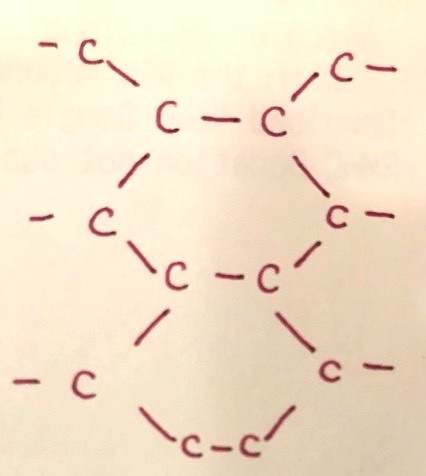
The structure of the carbon atoms in graphite is a repeating hexagonal structure like this.
Observe that the carbon is only attached to three other neighbouring carbon atoms (three lines drawn out from each carbon). This means that each carbon atom only uses three of its four valence electrons for bonding, leaving behind one electron which is free to move around (since they have nowhere else to bond to).
This explains why graphite can conduct electricity.
Date Posted:
7 years ago
Annela, you can do a Google search of “graphite structure” to see how the “hexagons” are arranged.

But silicon dioxide has 3 D shape and i dont understand why does it have atoms that have 4 covalent bonds
Good evening Annela! So sorry for the delayed response.
I had to do a Google search on this to see the structure.
https://www.chemguide.co.uk/atoms/structures/giantcov.html
You can see in the pictorial that the carbon atoms (in black) are each bonded to four oxygen atoms while the oxygen atoms are each bonded to two carbon atoms.
This article also lists out the cases for graphite and diamond.
Poly(ethene) can be thought of as a "never-ending alkane", where four-way bonding occurs in almost every carbon present.

 360 Tutoring Program