Lucius Ho's answer to Nur Ayuni Yazid's Secondary 3 E Maths question.
done
{{ upvoteCount }} Upvotes
clear
{{ downvoteCount * -1 }} Downvotes

Didn't answer (a) since I saw that you had the answer there.
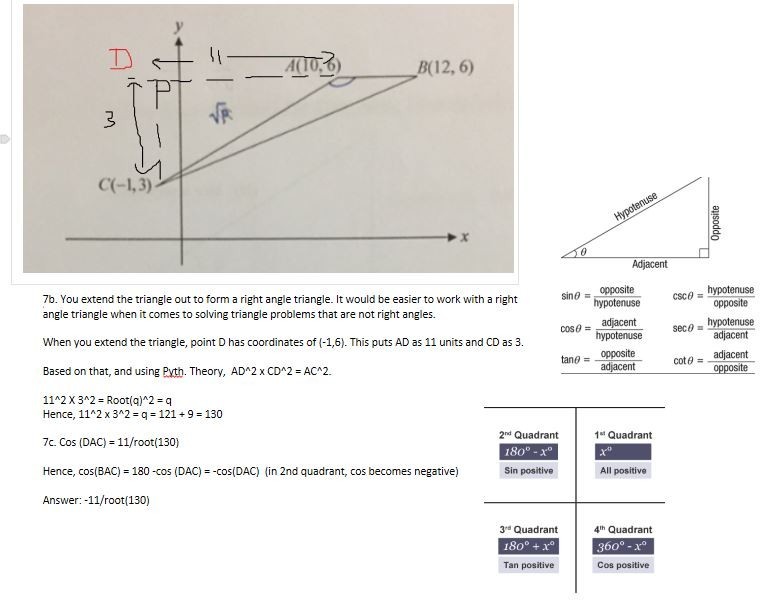
For (c), you use triangle BCD to figure out tan (ABC) = opposite/adj = 3/(11+2) = 3/13
(d) Given ABCD is a parallelogram, it means D must be on the same level as C (hence, y coordinate of D = 3) and that the distance between AB should be the same as CD (i.e. 2 units).
Therefore, D( -1+2, 3) = D(1,3)
OR
D (-1-2, 3) = D (-3,3)
They didn't state if D is in which side of the axis, so technically there's two possible points (you might want to draw out the two parallelograms if you don't understand).
Date Posted:
9 years ago

 360 Tutoring Program