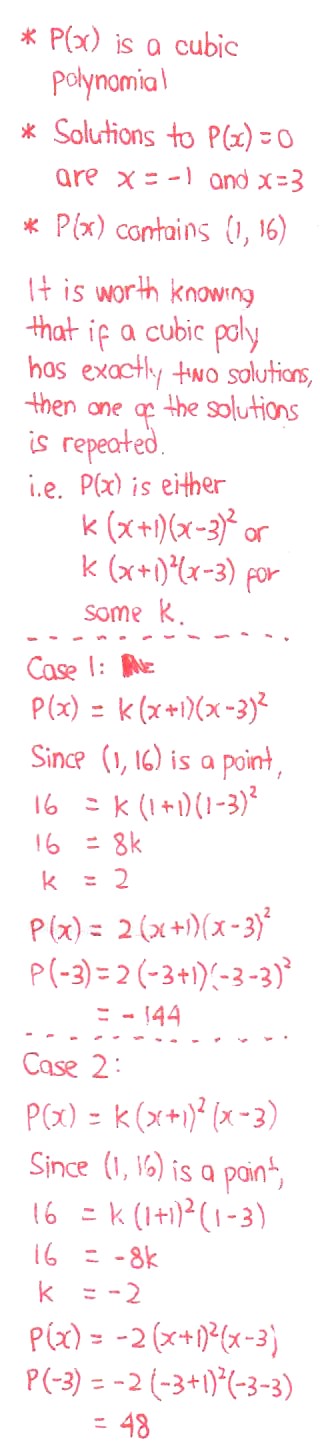
Eric Nicholas K's answer to Math123's Secondary 3 A Maths Singapore question.
done
{{ upvoteCount }} Upvotes
clear
{{ downvoteCount * -1 }} Downvotes

It is worth knowing that a cubic curve cuts the x-axis at least once.
If a cubic curve cuts the x-axis at three points, it means that there are three real and distinct points (means that you can clearly see three different cuttings at the x-axis).
If a cubic curve cuts the x-axis at two points, it means that there are two real and distinct points, of which one of the points is 'repeated'. In human view though, this means that the curve barely 'touches-and-goes' the x-axis at the 'repeated' point (or in other words, there is a turning point there, which could be a minimum point or a maximum point).
If a cubic curve cuts the x-axis at only one point, then there can only be one real point. The other two points do not exist, or at least, they are 'not real'.
It's very similar to the idea of the discriminant of roots for a quadratic equation, and in fact, these comcepts are related (since factoring out a linear expression from a cubic expression gives a quadratic expression anyway).
Date Posted:
7 years ago

 360 Tutoring Program