Ask Singapore Homework?
Upload a photo of a Singapore homework and someone will email you the solution for free.


Question
secondary 3 | A Maths
2 Answers Below
Anyone can contribute an answer, even non-tutors.

Pls help me with question 14
Date Posted: 7 years ago
Views: 734
See 2 Answers
done
{{ upvoteCount }} Upvotes
clear
{{ downvoteCount * -1 }} Downvotes
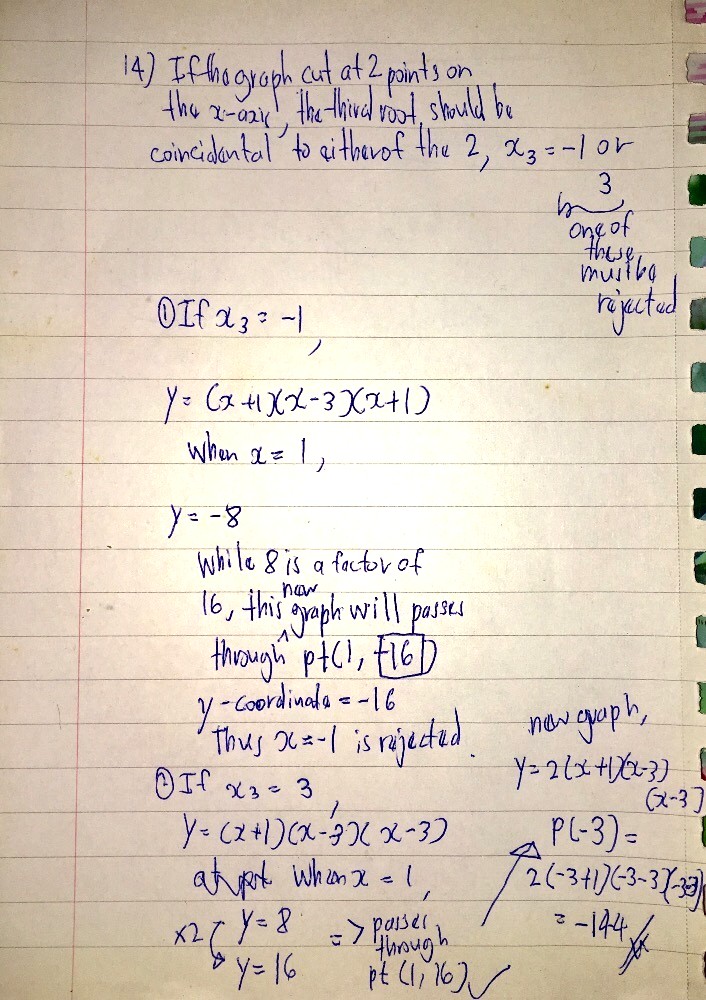
These are the steps required of you.It's important for you to know that the 3rd root is equal to one of the two (x=-1 or x=3) roots first..Only then can you move on.Use trial and error to check if your y coordinate is 16..However,both roots will give you 8 and -8 respectively instead of 16..Calm down..Isn't 8 a factor of 16?.Absolutely.Times 2 to the values of 8 for both..Reject the one which have a negative value for 16..As you times 2 to the positive y coordinate of 8,times 2 to the graph.Your new graph should look like this,Y=2(x+1)(x-3)(x-3)..Substitute -3 to find the value of y..With that,you are done..Hope this helps. :)
Date Posted:
7 years ago
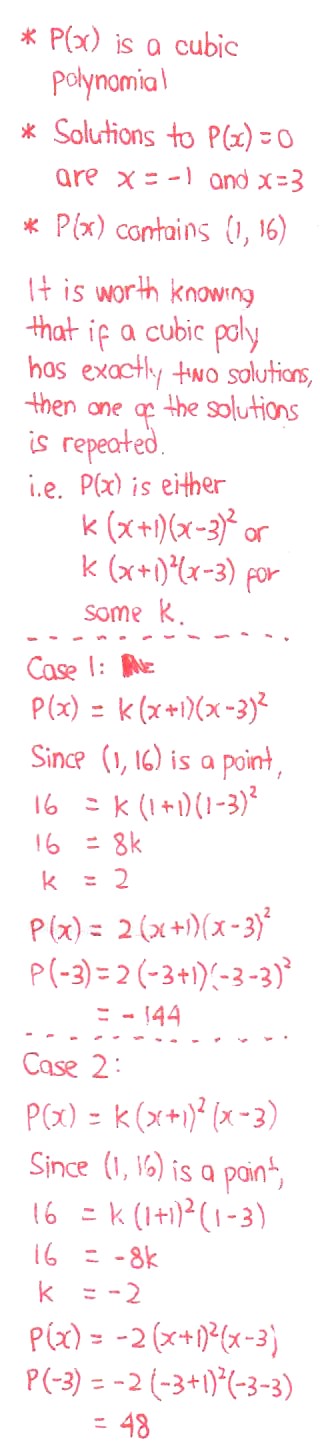
Oops I take back my word..You don't have to reject since you can times -2 to the one with negative 8.So You should have two answers for x=-3.This is shown by the other tutor..So,you don't have to reject any values as there are two possibilities to the graph..Sorry I mistook the 'values' as value on the last line..That's why I did the rejection part..
done
{{ upvoteCount }} Upvotes
clear
{{ downvoteCount * -1 }} Downvotes

It is worth knowing that a cubic curve cuts the x-axis at least once.
If a cubic curve cuts the x-axis at three points, it means that there are three real and distinct points (means that you can clearly see three different cuttings at the x-axis).
If a cubic curve cuts the x-axis at two points, it means that there are two real and distinct points, of which one of the points is 'repeated'. In human view though, this means that the curve barely 'touches-and-goes' the x-axis at the 'repeated' point (or in other words, there is a turning point there, which could be a minimum point or a maximum point).
If a cubic curve cuts the x-axis at only one point, then there can only be one real point. The other two points do not exist, or at least, they are 'not real'.
It's very similar to the idea of the discriminant of roots for a quadratic equation, and in fact, these comcepts are related (since factoring out a linear expression from a cubic expression gives a quadratic expression anyway).
Date Posted:
7 years ago


 360 Tutoring Program