Mathaddict100's answer to Alexia Hsu's Secondary 4 A Maths Singapore question.
done
{{ upvoteCount }} Upvotes
clear
{{ downvoteCount * -1 }} Downvotes
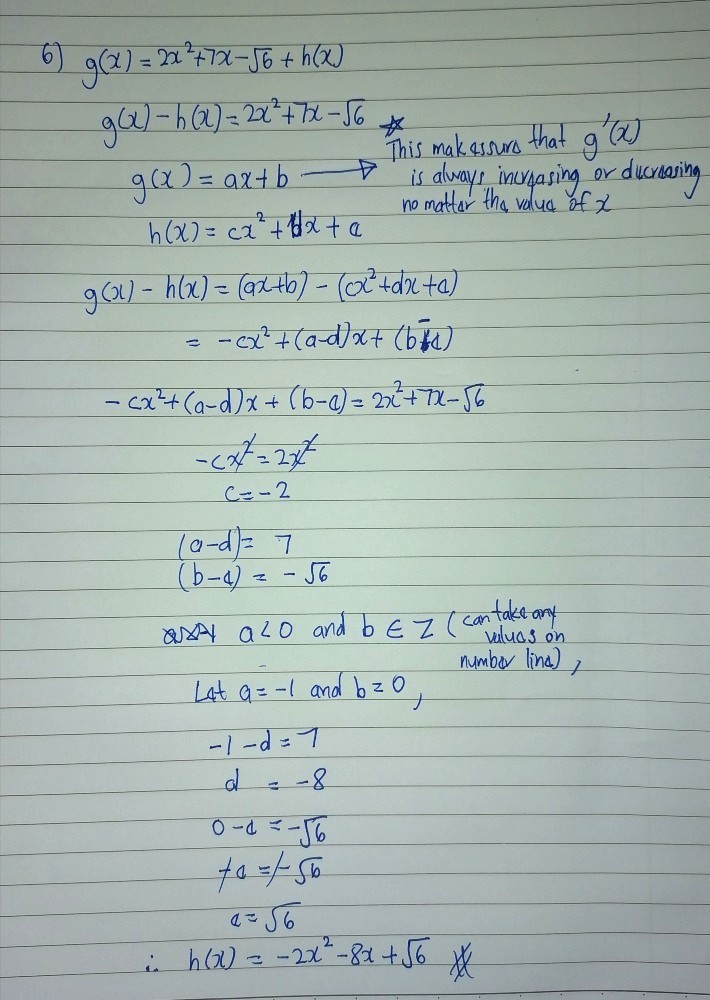
Hi. Though I'm not 100% confident, this is the best i could give you. Point to note is that the function g(x) must be linear. Otherwise, gradient of g(x) or g'(x) will be changing and not constant(increasing/decreasing) for all values of x. Then, a < 0. So that, g'(x) is always decreasing as per intended by question. The rest should be choosing our own a and b values. Hope it helps. :)
Date Posted:
5 years ago

Not really. g(x) isn't necessarily linear.
A linear g(x) is just one of the possible solutions.
some examples whereby g(x) isn't linear but still is a decreasing function :
g(x) = -√x
g(x) = -e^x
g(x) = -ln x
g(x) = -x³ - x² - x
A linear g(x) is just one of the possible solutions.
some examples whereby g(x) isn't linear but still is a decreasing function :
g(x) = -√x
g(x) = -e^x
g(x) = -ln x
g(x) = -x³ - x² - x

 360 Tutoring Program