Ask Singapore Homework?
Upload a photo of a Singapore homework and someone will email you the solution for free.

Question
secondary 4 | A Maths
2 Answers Below
Anyone can contribute an answer, even non-tutors.
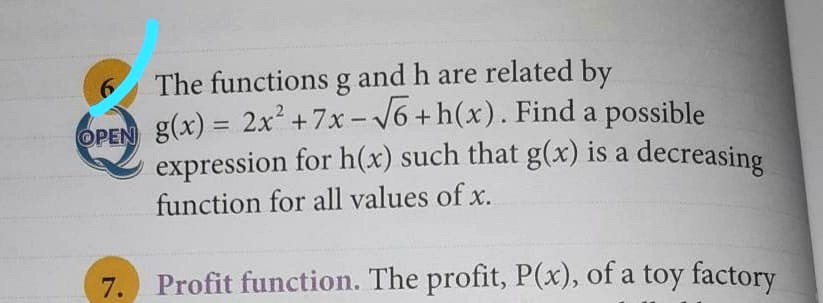
hi! may i get some help with how to approach this question.. "open" means you can set your own values!
Date Posted: 5 years ago
Views: 224
See 2 Answers
'Open' means that the question is open-ended i.e there are many possible answers.
g(x) = 2x² + 7x - √6 + h(x)
Differentiate with respect to x,
g'(x) = 4x + 7 + h'(x)
For g(x) to be a decreasing function for all values of x, g'(x) < 0 for all real values of x (i.e gradient is always negative and g(x) always decreases as x increases)
So, 4x + 7 + h'(x) < 0 for all real values of x.
There are three ways to think about it :
① h'(x) < -4x - 7
If h'(x) was a function that represents a straight line with gradient -4 and has y-intercept lower than -7, then for every real value of x, h'(x) will be smaller than -4x - 7 and this line will always be below the line of y = -4x - 7.
So h'(x) = -4x + a, where a < -7
Eg. h'(x) = -4x - 8, h'(x) = -4x -7.01, h'(x) = -4x - 50, etc.
Then, integrating back gives us h(x) = -2x² + ax + c (c is a constant, you can choose any real value)
So one possible solution is h(x) = -2x² - 8x + 3.
This results in g(x) = -x + √6 + 3, and g'(x) = -1, which is < 0 for all real x.
② g'(x) = 4x + 7 + h'(x)
As long as there is a term in x, g'(x) could vary between positive, 0 and negative. So we should have a -4x term in h'(x) to get rid of it. Then, to make g'(x) < 0, h'(x) should have a term than is smaller than -7, so we end up having a negative constant overall.
So h'(x) could be = -4x - 10 for example, which means g'(x) = -3 < 0 for all real x.

③
g(x) = 2x² + 7x - √6 + h(x)
g'(x) = 4x + 7 + h'(x)
We could also make h'(x) such that g'(x) becomes a quadratic expression which is always < 0.
If we let g'(x) = -a(x + b)² - c
Since -a(x + b)² ≤ 0 for all real x and b, where a > 0,
then -a(x + b)² - c < 0 for all real x and b, where a,c > 0
Eg. g'(x) = -5(x + 3)² - 6, which < 0 for all real x
Then, -5(x + 3)² - 6 = 4x + 7 + h'(x)
h'(x) = -5(x + 3)² - 6 - 4x - 7
h'(x) = -5x² - 30x - 45 - 6 - 4x - 7
h'(x) = -5x² - 34x - 58
Integrating with respect to x,
h(x) = -5/3 x³ - 17x² - 58x + c (c is a constant).
Some other examples whereby g(x) isn't linear but still is a decreasing function :
g(x) = -√x
g(x) = -e^x
g(x) = -ln x
g(x) = -x³ - x² - x
g(x) = -6x^5 + 5x⁴ + 3x³ - 2x² - 9x
From setting g(x) to equal these, you can determine what h(x) is.
g(x) = -√x
g(x) = -e^x
g(x) = -ln x
g(x) = -x³ - x² - x
g(x) = -6x^5 + 5x⁴ + 3x³ - 2x² - 9x
From setting g(x) to equal these, you can determine what h(x) is.
Hi. Thanks for giving another perspectives to this qn. Explanation is compact yet very clear. Definitely agree with most of your points. Especially on the inequalities part. Yes, i also agree on g(x) being non-linear.
That did not cross my mind as i only thought of straight lines. However, for g(x) to be logarithmic or square root in nature would lead to having constraints. g(x) is decreasing only at certain range (exp. x>0 for we know x should not be negative for both the functions) and not all x values.
I seek for your clarification. Thank you.
The part 'for all values of x' could be interpreted two ways :
① g(x) is a decreasing function for all real values of x for the domain where it is actually defined.
Eg . g(x) = -lnx , where x ∈ R , x > 0
Eg. g(x) = -√x, where x ∈ R , x ≥ 0
② g(x) must be defined for all real values of x.
g(x) = -e^x , where x ∈ R
So those two functions belong to interpretation ①
I did consider this when commenting but since the question wasn't very specific , possible solutions for both interpretations were given.
Strictly speaking 'all values of x' should include complex and imaginary numbers as well.
But since this is O level standard, they probably meant only real numbers.
But since this is O level standard, they probably meant only real numbers.
Ah i see. It depends on how the qn is interpreted. Now it makes sense. Thanks. To comment on the qn, its good the qn is not specific. It opens up to many possibilities rather than one or two. Oops. Sorry for using range instead of domain. Haha i just noticed.
Yes. Complex or imaginary numbers are non-existent yet. They appear later in post secondary studies.
Yea, it's meant for students to exercise their thinking skills , use some creativity perhaps and broaden their horizons.
In my opinion,
Older styles of questions and drills tend to make students' thinking very constrained and one-dimensional.
They are able to execute the operations, steps and formulas but when conceptual questions are asked , many struggle.
This is because they have not understood the concept and its derivations fully
done
{{ upvoteCount }} Upvotes
clear
{{ downvoteCount * -1 }} Downvotes
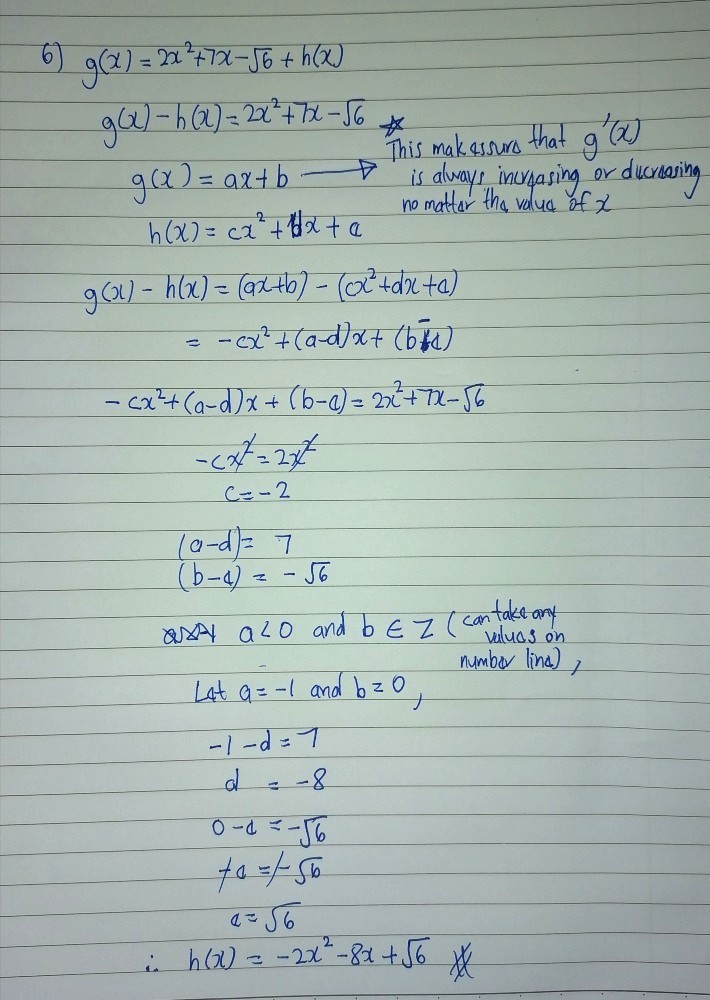
Hi. Though I'm not 100% confident, this is the best i could give you. Point to note is that the function g(x) must be linear. Otherwise, gradient of g(x) or g'(x) will be changing and not constant(increasing/decreasing) for all values of x. Then, a < 0. So that, g'(x) is always decreasing as per intended by question. The rest should be choosing our own a and b values. Hope it helps. :)
Date Posted:
5 years ago
Not really. g(x) isn't necessarily linear.
A linear g(x) is just one of the possible solutions.
some examples whereby g(x) isn't linear but still is a decreasing function :
g(x) = -√x
g(x) = -e^x
g(x) = -ln x
g(x) = -x³ - x² - x
A linear g(x) is just one of the possible solutions.
some examples whereby g(x) isn't linear but still is a decreasing function :
g(x) = -√x
g(x) = -e^x
g(x) = -ln x
g(x) = -x³ - x² - x


 360 Tutoring Program