Ask Singapore Homework?
Upload a photo of a Singapore homework and someone will email you the solution for free.


Question
secondary 4 | A Maths
One Answer Below
Anyone can contribute an answer, even non-tutors.

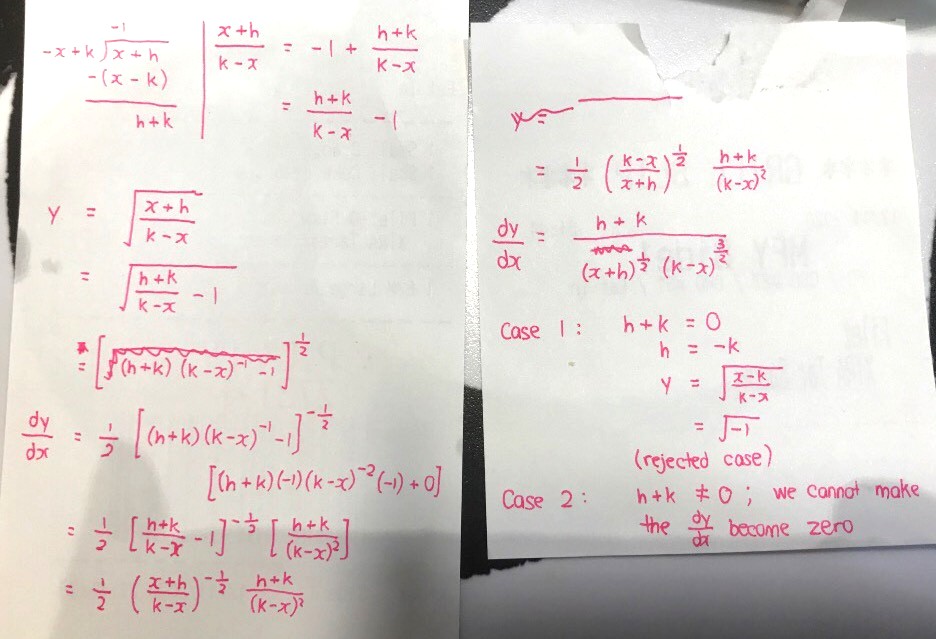
Hi, could you kindly help to review this A maths question and advise me the working solution? Thanks a lot!
Date Posted: 6 years ago
Views: 487

(x + h) / (k - x)
= -(-x - h) / (k - x)
= -(k - x - h - k) / (k - x)
= -(k - x) / (k - x) + (h + k) / (k - x)
= (h + k)/(k - x) - 1
= -(-x - h) / (k - x)
= -(k - x - h - k) / (k - x)
= -(k - x) / (k - x) + (h + k) / (k - x)
= (h + k)/(k - x) - 1

Good evening Candice! I will look at this later if I have time
So,
y = √[(x + h)/(k - x)]
= √[(h + k)/(k - x) - 1]
= [(h + k)/(k - x) - 1]¹/²
dy/dx
= ½[(h + k)/(k - x) - 1]-¹/² (-(-1)(h+k)/(k-x)²)
= ½[(h + k)/(k - x) - 1]-¹/² (h+k)/(k-x)²
= (h+k) / ( 2(k-x)²[(h + k)/(k - x) - 1]¹/² )
= (h+k) / ( 2(k-x)²√[(h + k)/(k - x) - 1] )
Now, the line y = 3.5 has a gradient of 0, since it is horizontal and parallel to the x-axis.
For the tangent of a point on the curve to be parallel to y = 3.5, its gradient also has to be 0.
This means at that point, dy/dx = 0
But if dy/dx = 0, then h + k = 0
(the denominator cannot be 0 as it would lead to an undefined result. So the numerator has to be 0)
But, if h + k = 0, then
y = √[0/(k - x) - 1]
y = √-1
The square root of a negative real number gives a non-real or imaginary number .
(√-1 = i, this will be taught at A levels)
This means the value of y is a non-real or imaginary.
So for real values of x and y, there is no point on the curve where the tangent has a gradient of 0.
There is a quick and intuitive method to do part two since graphs of y = k/x do not have turning points by default
Well, you'll still have to explain why that is so.
i.e dy/dx ≠ 0 for all real x
i.e dy/dx ≠ 0 for all real x
See 1 Answer
done
{{ upvoteCount }} Upvotes
clear
{{ downvoteCount * -1 }} Downvotes
Candice, we have to prove that dy/dx cannot equal zero (because the gradient of the line y = 3.5 is zero).
There are two cases to consider here; if h + k = 0, the curve does not even exist; in all other cases, we cannot make dy/dx zero since we cannot equate the denominator to zero in attempting to obtain a zero gradient.
There are two cases to consider here; if h + k = 0, the curve does not even exist; in all other cases, we cannot make dy/dx zero since we cannot equate the denominator to zero in attempting to obtain a zero gradient.
Date Posted:
6 years ago
Missed out the “1/2” in my final expression for dy/dx
Candice, a point to take note :
It is actually possible for the denominator of dy/dx to become 0.
That is when x = -h. Which means
y = √((-h+h)/(k-x)
y = √0/(k-x)
= √0
= 0
This means that for the point (-h,0), the slope or gradient ( i.e dy/dx) is undefined since the denominator of dy/dx = 0
If k = x, then y would be undefined since :
y = √(h+x)/(k-k)
y = √((h+x)/0)
The denominator is 0 here. So there is no point on the curve where x = k.
And, when x = k, the denominator of dy/dx also is 0, which means the gradient is undefined.
(Which is quite obvious, since there cannot be any gradient , when the point is not even defined in the first place.)
This also reminds us that x = k is a vertical asymptote of the curve.
Thank you so much, Mr Eric. I really appreciate your help to provide me with the working solution :)
Thanks again !
Thanks again !
yes Mr Eric, I do notice the missing "1/2" :)
I've added it myself into the working solution provided by you. Thanks for highlighting.
I've added it myself into the working solution provided by you. Thanks for highlighting.
Noted your point, Mr J. Thanks.
I actually left an explanation in the main comments section way earlier before this post was even up. His working is similar to mine. Hope you saw it
yes Mr J. Almost missed out the earlier comments by both you and Mr Eric. So sorry...my apologies.
I have just managed to digest it :) Thank you so much for taking time to provide me with the explanation.
I have just managed to digest it :) Thank you so much for taking time to provide me with the explanation.


 360 Tutoring Program