Matthew Soon's answer to LockB's Secondary 4 A Maths Singapore question.
done
{{ upvoteCount }} Upvotes
clear
{{ downvoteCount * -1 }} Downvotes
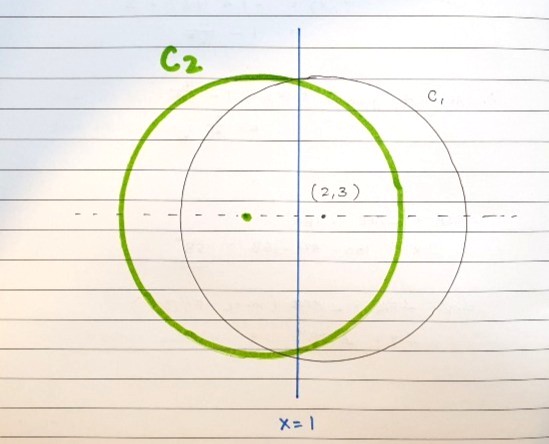
No worries. I'll explain using this:
You see C1 drawn in black here, with center (2,3).
If I reflect C1 about x = 1, what this means is that imagine I use the line x = 1 (blue line) as a mirror for C1, I will get a new circle (green) C2.
Because I 'mirrored' the circle, all its coordinates will be 'mirrored' as well - including the center of the circle. Like how a mirror works, the distance of something on one side must be the same distance as its reflection.
Since the center (2,3) is 1 unit away from the line x = 1 horizontally, the new center (green dot) must also be 1 unit away from the x = 1. So the new center is (0,3).
Given this new center of circle C2, you may apply the circle formula to get the new equation as such:
(x-0)^2 + (y-3)^2 = r^2
Hope this is better!
Date Posted:
5 years ago

 360 Tutoring Program