Eric Nicholas K's answer to Candice lim's Secondary 4 A Maths Singapore question.
done
{{ upvoteCount }} Upvotes
clear
{{ downvoteCount * -1 }} Downvotes

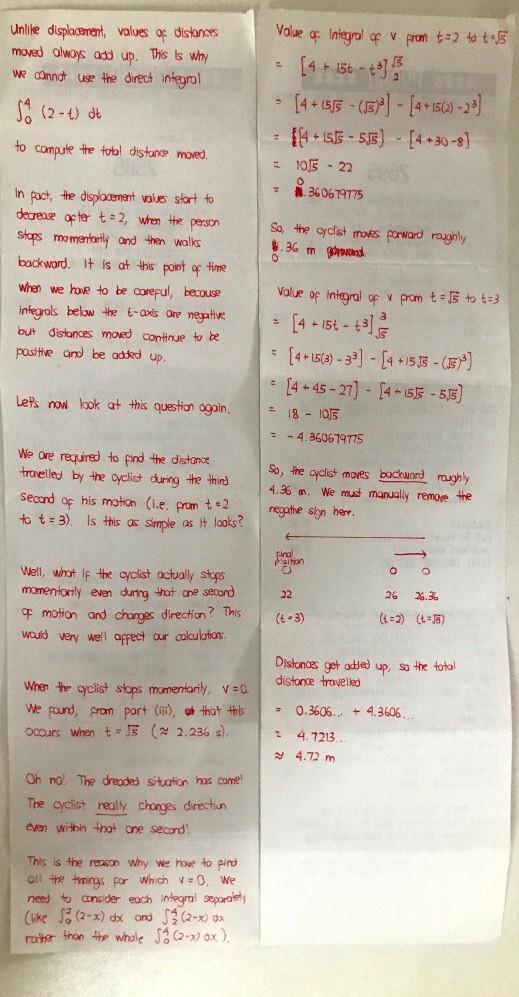
Good afternoon Candice! This forms the third and final part of my workings.
If we forget to count the intermediary t = sqrt 5 in our diagrams and just simply remove the negative sign at the end of the calculations, it will be akin to integrating the expression (2 - x) directly from x = 0 to x = 4 without checking the cross-over point x = 2. Our obtained values would have been the relative displacement between the two positions.
If we forget to count the intermediary t = sqrt 5 in our diagrams and just simply remove the negative sign at the end of the calculations, it will be akin to integrating the expression (2 - x) directly from x = 0 to x = 4 without checking the cross-over point x = 2. Our obtained values would have been the relative displacement between the two positions.
Date Posted:
5 years ago
In summary, we need to check whether the question asks for the displacement of the object or the distance travelled by the object.
If the question asks for the "total distance travelled by an object", then
- the question is asking for the total length covered
- we must find the point where the object turns i.e. when v = 0
- we need to segregate the portions of motion based on these time regions (in my example, it would be considering regions t = 0 to t = 2 and t = 2 to t = 4 separately)
- calculate each integral separately and remove any negative sign present in each region
- add these values together to find the total distance travelled
- diagrams like those Mr Ang has included are very helpful in visualising this
Only if there are no values of t for which v = 0, we can just integrate the expression directly in one sitting, which will be similar to displacement,
If the question asks for the "distance of the object from a point", then
- the question is asking for the displacement
- directions really matter, because we need to subtract backward motions from forward motions
- the integral must be done in one single sitting throughout and not be split, unlike the case of the distance travelled (i.e. integrate from x = 0 to x = 4 directly without doing x = 2 in my example).
The words which we need to look out for are "travelled" or "moved".
This will determine whether we are trying to find the distance moved or the displacement of the object.
This will determine whether we are trying to find the distance moved or the displacement of the object.

Wow! Good afternoon Mr Eric, thank you so much for your detailed explanation. I really appreciate your time and effort to furnish me with such great details and excellent advice!
THANK YOU VERY MUCH :)
THANK YOU VERY MUCH :)

 360 Tutoring Program