leanne's answer to Fuzzy's Primary 4 Maths Singapore question.
done
{{ upvoteCount }} Upvotes
clear
{{ downvoteCount * -1 }} Downvotes

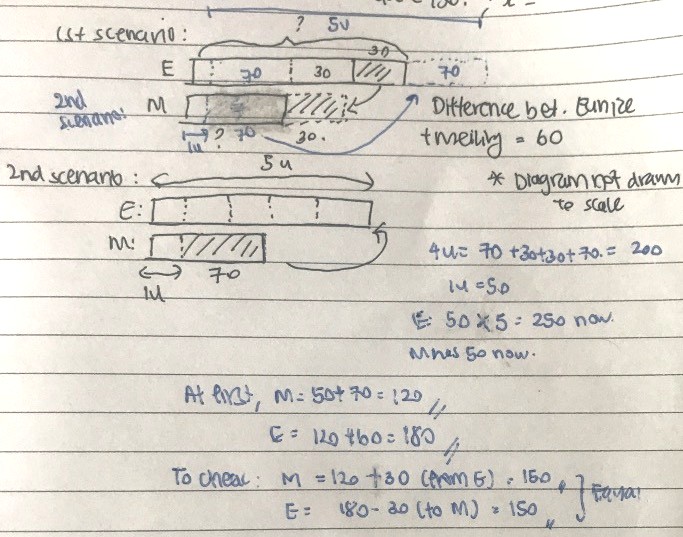
I combined 2nd scenario where mei ling gives 70 cookies to Eunice, into model #1, in blue.
1st scenario using model, tells us the number difference between both girls is 60.
Hope this helps!
1st scenario using model, tells us the number difference between both girls is 60.
Hope this helps!
Date Posted:
6 years ago

The model for your second scenario is not correct.
Eunice only has 5 times of Mei Ling when Mei Ling gives her 70.
But you have already drawn Eunice as 5 units even before the transfer has occurred.
Eunice only has 5 times of Mei Ling when Mei Ling gives her 70.
But you have already drawn Eunice as 5 units even before the transfer has occurred.
Thanks J. That was just to show understanding, that after the transfer, it is 5x of the other girl. The crux is in the first model where I transfer everything in one model. If it helps, can just disregard the second model as it’s just to show both links to guide the student.
Yup can understand your intention, and your first model and working/answers are very correct.
My concern is more of :
70 being there would result in confusion for students and may lead them to interpret that 130 cookies = 4 units, or if viewed in another perspective, 2 units = 60, when they compare the two models to try to find 2 unit.
Inadvertently the student risks getting misguided and ends up with the wrong answer.
Presentation wise, the marker will also deem it incorrect and loss of marks may result.
At P4 , students are still very visual and will interpret things upon first impression.
Understand your concern here, thank you.
As for markers, the train of thoughts are also important as evident by what they show in their workings. If some loss of marks were to be lost in this case, it’s also minimal, and wouldn’t affect a grade change, so long as a student shows understanding of concepts.
Would just like to highlight that perceptions of individuals are different as well. Have a good weekend ahead.
For such questions , I will generally show the models like this : (see the main comments section for my working and explanations)
Scenario if Eunice gives Mei Ling 30 :
Before :
E ⬛|30|30|
M⬛
After :
E ⬛|30|
M⬛|30|
Scenario if Mei Ling gives Eunice 70 :
Before :
E □|70|60|
M□|70|
After :
E □|70|60|70|
M□
Redrawn as
E □□□□□
M□
For clarity purposes : ⬛ = □ + 70
Generally at P4, students aren't quite able to visualise the transfers within one model. They get confused with too many boxes and dotted lines drawn.
A before/after scenario is usually (with appropriate arrows, which I can't replicate here)
Will have to respectfully disagree with your notion of minimal loss of marks and that it wouldn't affect a grade change.
Every mark matters and very often it is that 0.5 or 1 mark that distinguishes the A* from A, A from B (AL1 from AL2 from 2021. Accumulation of losses of such small numbers of marks across different questions becomes very significant as well.
It would even be more significant given that the AL system is much like L1R5 in O levels and that 1 point difference can make a huge difference in getting to the school of choice.
This in turn affects the child's confidence, self-esteem, the environment he's placed amongst other implications.
Students should be as mathematically correct, logically sound and accurate in their answers as possible, leaving no room for error or penalisation, so as to secure the maximum marks.
As for understanding of concepts, if the working is wrong due to an incorrectly drawn model (excludes models not scale or proportion), it shows that the conceptual understanding isn't firm. If it were firm, the student would already have reinspected his model and made the necessary changes.
However, if the working is correct, then there's not much of an issue and it is more of accuracy.
Will agree with you that for individuals, perceptions differ. Just my 2 cents here.
Thanks and you have a good day too.

 360 Tutoring Program