Eric Nicholas K's answer to LockB's Secondary 3 A Maths Singapore question.
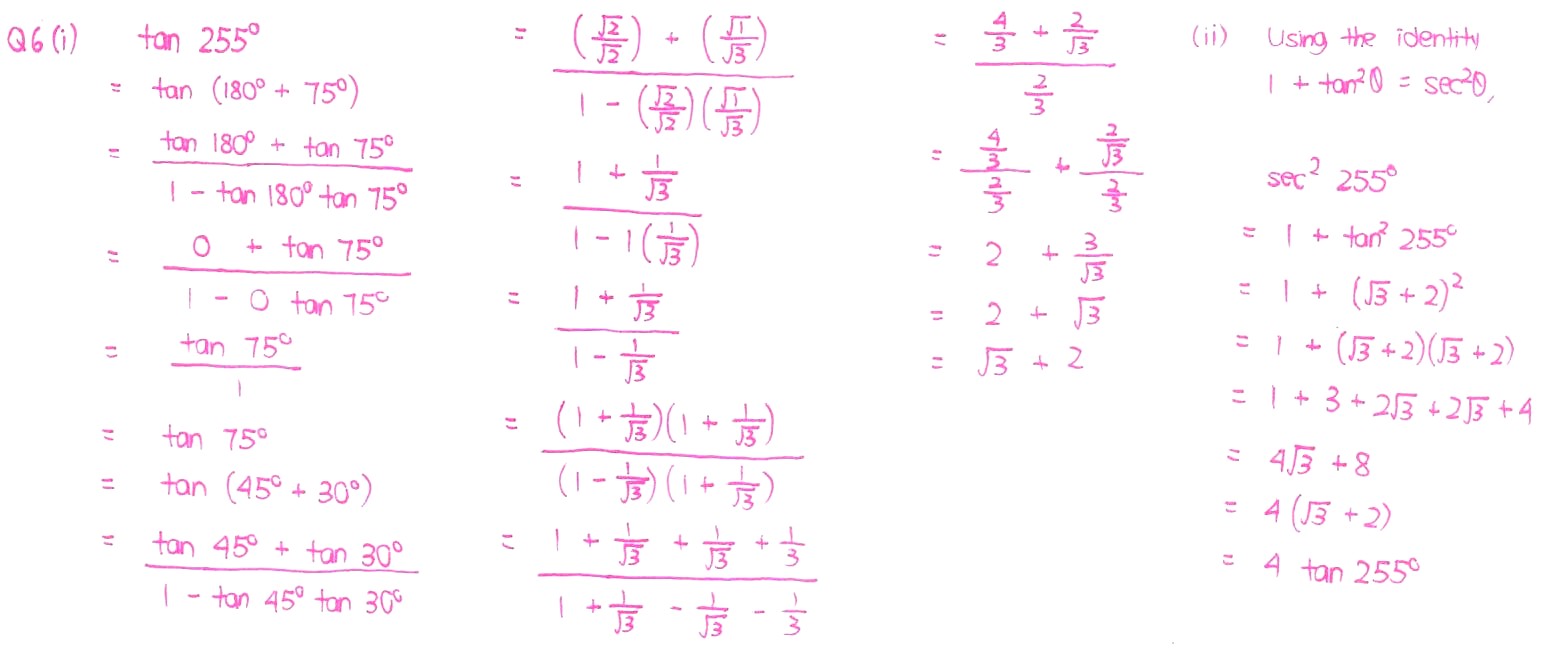
done
{{ upvoteCount }} Upvotes
clear
{{ downvoteCount * -1 }} Downvotes

Q6
I will only look at Q3, Q4 and Q5 some other time if I am free and I can remember. Also, I won't be answering questions in this forum that frequently anymore due to increased workload.
I will only look at Q3, Q4 and Q5 some other time if I am free and I can remember. Also, I won't be answering questions in this forum that frequently anymore due to increased workload.
Date Posted:
6 years ago

do sin cos tan 180 and 360 equates to either 1 or 0? if so, does that mean for these type of questions when we cant add or subtract the special angles to get the number we want to obtain then we will just use 180 or 360?
at part (i), how did 2 + 3/ sqrt 3 become 2 + sqrt 3
btw when sec^2 x become 1 + tan^2 x, why isnt the 255 times by 1 which makes it 255 + 255 tan^2 x
"do sin cos tan 180 and 360 equates to either 1 or 0? if so, does that mean for these type of questions when we cant add or subtract the special angles to get the number we want to obtain then we will just use 180 or 360?"
These are some further special angles to know
sin 0 = 0
sin 90 = 1
sin 180 = 0
sin 270 = -1
sin 360 = 0
cos 0 = 1
cos 90 = 0
cos 180 = -1
cos 270 = 0
cos 360 = 1
tan 0 = 0
tan 90 = undefined
tan 180 = 0
tan 270 = undefined
tan 360 = 0
--------------------------------------------------------
"at part (i), how did 2 + 3/ sqrt 3 become 2 + sqrt 3"
We need to rationalise 3 / sqrt 3 by multiplying both the numerator and the denominator by sqrt 3. Alternatively, we can write the 3 in the numerator as sqrt 3 times sqrt 3. Or, we can even use indices to see this.
--------------------------------------------------------
"btw when sec^2 x become 1 + tan^2 x, why isnt the 255 times by 1 which makes it 255 + 255 tan^2 x"
The 255 is an angle and is not supposed to be multiplied to the "1". The "1" is fixed regardless of the angle. You must be able to distinguish between an angle, especially in degrees, and a numerical value.
In other words, tan 255 is not the same as 255 x tan 1.

 360 Tutoring Program