Eric Nicholas K's answer to LockB's Secondary 3 A Maths Singapore question.
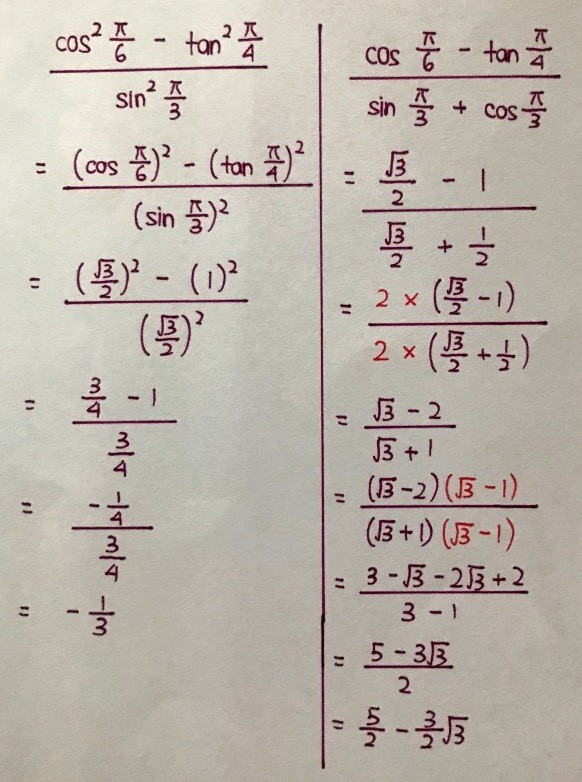
done
{{ upvoteCount }} Upvotes
clear
{{ downvoteCount * -1 }} Downvotes

Note that cos^2 x means (cos x)^2 and so on. Same goes for cos^3 x = (cos x)^3. It’s a standard definition.
Date Posted:
6 years ago

for these kind of questions we need to do it the surds way?
btw if they never mention "without using a calculator" can we just skip the surds presentation and go ahead with the first part (just subbing in the special values), type into the calculator and give the answer?
if i type into the calculator i will get the answer in decimal form instead of surds form (thats what i did just now as i didnt know i have to solve it using surds method)
You can use the special angles table and memorise them. It's a must to memorise them. You can use either format to remember.
They are unlikely to ask for "without using a calculator" for such questions, especially if special angles 0, 30, 45, 60 and 90 (or the equivalent 0, pi/6, pi/4, pi/3 and pi/2) appear as the acute angle. If they do so, however, of course placing in the calculator is preferred.
The newer calculators are able to recognise numbers like sqrt 3 as sqrt. Our calculator, however, is not capable of detecting numbers like sqrt 3 and will present itself as decimal form instead.
One way to get over this is to do the following.
Type cos pi/3 (radian form) and you will get decimals (it's actually sqrt 3 divided by 2). Square it first to get a very nice fraction 3/4 (all my table values yield nice fractions when you square them). Then, put square roots on both the numerator and the denominator to get sqrt 3 / sqrt 4.
thx :)

 360 Tutoring Program