Eric Nicholas K's answer to Candice lim's Secondary 3 A Maths Singapore question.
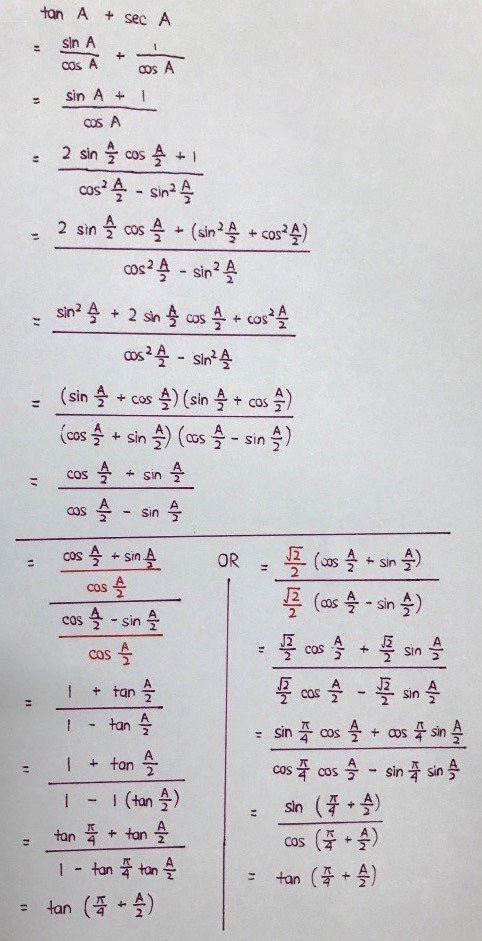
done
{{ upvoteCount }} Upvotes
clear
{{ downvoteCount * -1 }} Downvotes

Good evening Candice! Here is an approach to do from right to left.
Date Posted:
6 years ago

Thank you so much Mr Eric.
Seeking your advice on the following question I have in mind :
For proving, does it always have to be done from LHS to RHS (or vice-versa)? Can we cross-multiply the fractions on both sides and prove from there instead?
I’ve noticed that the examples on the textbook tend to just focus on working out one expression, and not interfere with the other.
Candice, when I attempted this question, I actually “cheated” by working halfway from the LHS and halfway from the RHS to meet a common point before I link them together.
Yes, it’s a perfectly valid approach, but at the end during the presentation, we must present it all the way from one end to the other.
Yes, it’s a perfectly valid approach, but at the end during the presentation, we must present it all the way from one end to the other.
Cross-multiplying fractions may not be a wise choice however, but objectively speaking, it’s not really wrong to do that since we just proved a very similar alternative version.
oic. haha...I have been doing this quite frequently for this topic.
Once again, thanks for your advice, Mr Eric.
Once again, thanks for your advice, Mr Eric.

No. Cross multiplying is not allowed. It's either LHS to RHS or RHS to LHS.
By doing cross multiplication, you are already assuming the equation is true. We cannot assume something is true when proving it. It's called circular logic.
Marks will be lost if done in exam.
By doing cross multiplication, you are already assuming the equation is true. We cannot assume something is true when proving it. It's called circular logic.
Marks will be lost if done in exam.
I guess that I have caused some confusion. What I meant was that working to the middle from each side and then reconnecting them in a single path from one end to the other is allowed.
Cross multiplication, I don’t recall much about it.
Cross multiplication, I don’t recall much about it.
If you choose to solve from both sides and then are able to link a result from one side's solving step to the other side's solving steps, you'll still have to represent everything by going backwards on either side's steps.
Sometimes, there is not much choice. To most of my students, they would give up a few steps into the lines which I have written.
Doing from both sides allows ideas to be linked more closely since there are much fewer intermediate steps from two middle workings than from the front to the end.
It’s like chaffeurs picking up tourists from an airport to a hotel. You come to this new country not knowing the directions. The chauffeur does not know the happenings in your home country. But allow the chauffeur to drive you to your booked hotel and you are able to reach the destination easily.
As mentioned, even if you reach a common point from either side, the presentation to be reshown as from 1 side to the other.
Doing from both sides is more of a last resort method if the student is unable to see the trick to continuing the steps from working in 1 direction.
Doing from both sides is more of a last resort method if the student is unable to see the trick to continuing the steps from working in 1 direction.
A more apt analogy would be :
There are 2 entrances to a maze. One can start from either side. The goal is to get from 1 entrance to the other.
Starting from either entrance, if you reach a common point, you have figured out the path linking both entrances.
There are 2 entrances to a maze. One can start from either side. The goal is to get from 1 entrance to the other.
Starting from either entrance, if you reach a common point, you have figured out the path linking both entrances.
I notice one trend among my students. If an identity involves angle pairs 2A and A, most of my students would be able to handle those identities. But when the exact same identity involves angles A and A/2 instead, even though it’s technically the same identity, most of them get stuck.
I think if this question uses 2A and A instead of A and A/2, it becomes more obvious to my students.
I think if this question uses 2A and A instead of A and A/2, it becomes more obvious to my students.
Being able to spot that analogous result, among other realisations, is what separates the better students from the rest.

 360 Tutoring Program