Eric Nicholas K's answer to MM's Secondary 4 A Maths Singapore question.
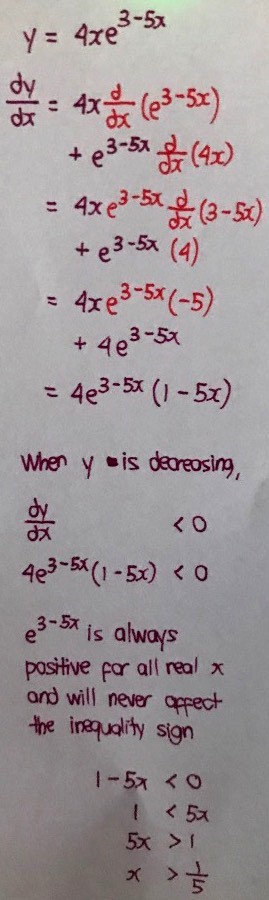
done
{{ upvoteCount }} Upvotes
clear
{{ downvoteCount * -1 }} Downvotes

An idea
Date Posted:
6 years ago

Y is incrasing function sir.
One doubt sir
Exponentional doe not accept inequality.
Is it correct
One doubt sir
Exponentional doe not accept inequality.
Is it correct
Oops, I mistook it for decreasing.
You can just change my signages accordingly.
So, 1 - 5x > 0
1 > 5x
5x < 1
x < 1/5
Any positive number, raised to any power, will always have a positive output. This is why exponentials like what you have seen will basically not affect inequality signs.
Putting it more mathematically,
e^(function in x) > 0 for all real values of x
So you can think of e^(function of x) as being blind to inequality signs like what you have noted.
The same goes for denominators and numerators containing things like
(x + 2)^2 + 5
where you are certain that the resultant output value from this expression exceeds 0.
In future studies, you will learn that if the denominator accepts positive and negative values, such as
3 / (x - 2) > 5,
we cannot conveniently cross multiply, because of the ambiguities with the signages that arise. For example, if x - 2 is positive, the signage does not change. If x - 2 is negative, the signage changes. But x - 2 can be either one, so does the signage change or not? This dilemma is the reason why things which an uncertain signage cannot be approached by cross multiplication.
At your level, you will face things which is “always positive” or “always negative”, as is the case for the exponential function which you have seen which is “always positive”. In such fixed cases, we have a deterministic signage to follow, so we can simply remove it from the equation.
Thank you sir for ur explanation
Thank you sir

 360 Tutoring Program