Eric Nicholas K's answer to Sonia's Junior College 2 H2 Maths Singapore question.
done
{{ upvoteCount }} Upvotes
clear
{{ downvoteCount * -1 }} Downvotes

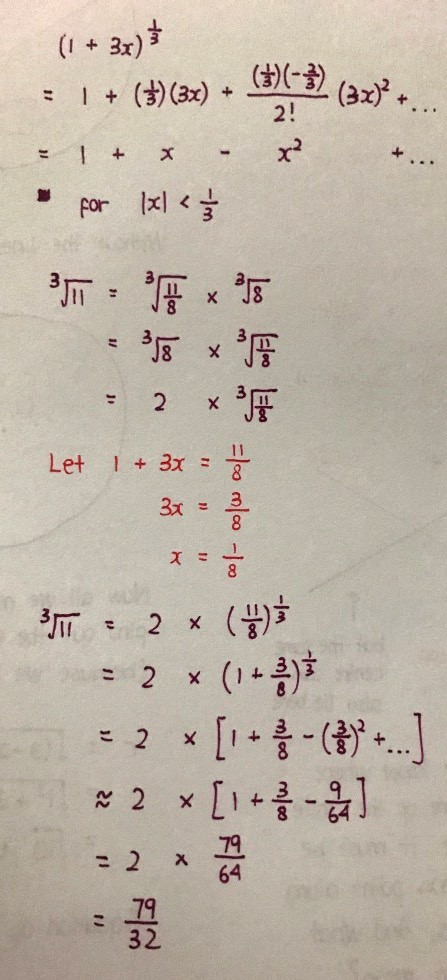
A very good evening to you Sonia!!! Here are my workings for this question. We can’t use x = 10/3 as a good estimate because this will lead to divergence of our expansion. This is why in the part before (i), the range of valid values of x are those within |x| < 1/3.
Date Posted:
6 years ago
Sonia, the idea here is to pick a good value such that our chosen x is within the range -1/3 and 1/3 and to pick two good numbers to multiply to 11 because the approximation is meant for us to be able to come up with an approximate value without the use of a calculator. Hence, I chose 8 x 11/8. Here, 7 x 11/7 is not appropriate because cube root 7 cannot be estimated immediately,
To be fair, even my choice x = 1/8 is a terrible approximation as the value is more than 10% off.
To be fair, even my choice x = 1/8 is a terrible approximation as the value is more than 10% off.

A another estimate would be :
³√11
= 11¹/³
= (27 x 11)¹/³
= 27¹/³ (11/27)¹/³
= 3 (1 - 16/27)¹/³
= 3 (1 + 3(-16/81) )¹/³
≈ 3 (1 + (-16/81) - (-16/81)²)
= 3 (1 - 16/81 - 256/6561)
= 3 (5009/6561)
= 5009/2187
( = 2 635/2187 ≈ 2.2904)
This is close to the ³√11 ≈ 2.22398009
The idea is, the closer your x is to 0, the better your estimate here
By the way, you put x = ⅛ but how come you're using x = ⅜ in your expansion?
Now that you mention it, I just realised I subbed in the wrong number.
Sonia, a correction:
cuberoot 11
= 2 times [1 + 1/8 - (1/8)^2 + ...]
~ 2 times [1 + 1/8 - 1/64]
= 2 times 71/64
= 71/32
cuberoot 11
= 2 times [1 + 1/8 - (1/8)^2 + ...]
~ 2 times [1 + 1/8 - 1/64]
= 2 times 71/64
= 71/32

Actually it’ll be pretty cool if we really consider “best approx” instead of a single value of x. In that case, we can look at the question as a chain of (1+3x)^1/3 ie (A+1)^1/3 which can be broken down further into A^1/3•(1+1/A)^1/3 etc until you get a to a perfect cube which in this case of cbrt(11) means 8^1/3=2.
11^1/3
=(10+1)^1/3 = (10)^1/3•(1+1/10)^1/3
=(9+1)^1/3• (1+1/10)^1/3 = (9)^1/3•(1+1/9)^1/3•(1+1/10)^1/3
= (8+1)^1/3 •(1+1/9)^1/3•(1+1/10)^1/3 = (8)^1/3•(1+1/8)^1/3•(1+1/9)^1/3•(1+1/10)^1/3 = 2•(1+1/8)^1/3•(1+1/9)^1/3•(1+1/10)^1/3
**edited away the additional 9^1/3
11^1/3
=(10+1)^1/3 = (10)^1/3•(1+1/10)^1/3
=(9+1)^1/3• (1+1/10)^1/3 = (9)^1/3•(1+1/9)^1/3•(1+1/10)^1/3
= (8+1)^1/3 •(1+1/9)^1/3•(1+1/10)^1/3 = (8)^1/3•(1+1/8)^1/3•(1+1/9)^1/3•(1+1/10)^1/3 = 2•(1+1/8)^1/3•(1+1/9)^1/3•(1+1/10)^1/3
**edited away the additional 9^1/3
I think you have an extra 9¹/³ in your last two steps
11¹/³
= (10 + 1)¹/³
= 10¹/³ (1 + 1/10)¹/³
= (9 + 1)¹/³ (1 + 1/10)¹/³
= 9¹/³ (1 + 1/9)¹/³ (1 + 1/10)¹/³
= (8 + 1)¹/³ (1 + 1/9)¹/³ (1 + 1/10)¹/³
= 8¹/³ (1 + 1/8)¹/³ (1 + 1/9)¹/³ (1 + 1/10)¹/³
= 2 (9/8)¹/³ (10/9)¹/³ (11/10)¹/³
= 2 (9/8 x 10/9 x 11/10)¹/³
= 2 (11/8)¹/³
= 2 (1 + 3(⅛) )¹/³
≈ 2 (1 + ⅛ - (⅛)²)
= 2 (71/64)
= 71/32
This leads to the same result as factoring out 8 in the first place.

 360 Tutoring Program