Eric Nicholas K's answer to j's Secondary 4 A Maths Singapore question.
done
{{ upvoteCount }} Upvotes
clear
{{ downvoteCount * -1 }} Downvotes

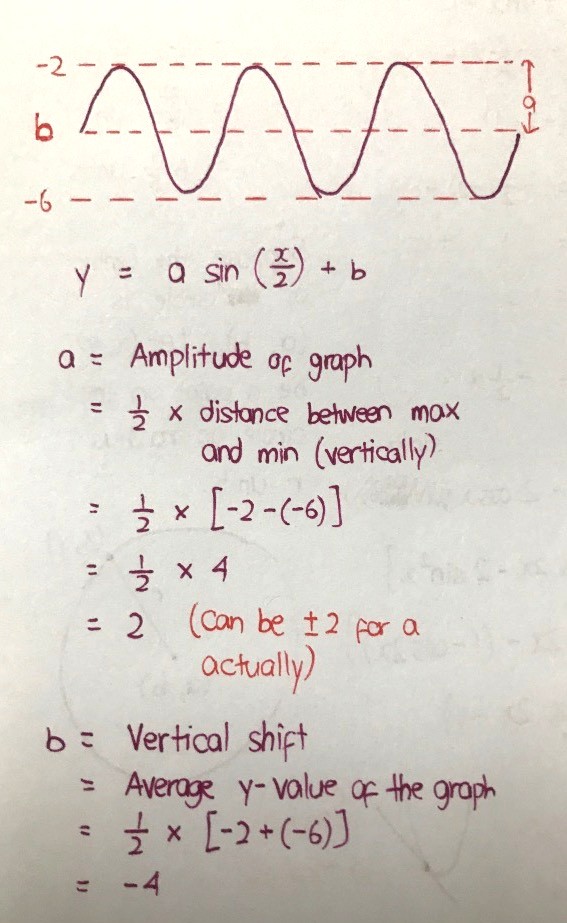
Good evening Lisa! Here are my workings for this question.
The amplitude measures the distance between the max (or the min) and the centre value of the graph, or in other words, half the vertical distance between the min and the max.
Here, the amplitude is 2. Amplitudes always have a positive value. However, in the equation, a can actually be +2 or -2, where the negative sign just dictates the direction the sine graph will go first.
Date Posted:
6 years ago

|a| = 2, if question does not state that a > 0
Technically the amplitude is a positive number, but a can be negative.
Like for example,
y = -2 sin x + 2
It’s a sine graph with an amplitude of 2 which starts its journey down to the minimum first instead of travelling up to the maximum.
Not sure if the syllabus teaches much of these...
Like for example,
y = -2 sin x + 2
It’s a sine graph with an amplitude of 2 which starts its journey down to the minimum first instead of travelling up to the maximum.
Not sure if the syllabus teaches much of these...
I teach my students the negative case in case it really appears in the O Levels (which I don’t recall ever coming out in past years at all).
negative just means it is a reflection about a certain line parallel to x-axis.
Eg. y = 2x - 3 and y = -2x - 3 are just reflections of each other about y = -3
y = 2sin x + 5 and y = -2sin x + 5 are just reflections of each other about y = 5.
Not explicitly covered but the student should know.
Eg. y = 2x - 3 and y = -2x - 3 are just reflections of each other about y = -3
y = 2sin x + 5 and y = -2sin x + 5 are just reflections of each other about y = 5.
Not explicitly covered but the student should know.
Weirdly enough my tuition students know how to draw things like y = |4x| but not things like y = 3 - |2x - 1|. It’s like their school teachers covered the basic modulus graph but not the more advanced ones.
They probably left it for A levels (transformation of graphs topic).
what they can do at this level (similar to TSST) :
Plot y = 2x - 1 first with a pencil.
Then apply the modulus (flip all negative portions below the x-axis up)
Then reflect everything about the x-axis.
Then translate upwards(vertically) by 3.
The alternative is one could plot y = -(2x - 1) = 1 - 2x first.
Then do a 'reverse modulus' and flip everything down. Then translate up by 3.
But this is harder to understand

Thankyou

 360 Tutoring Program