tricia's answer to tricia's Secondary 3 E Maths Singapore question.
done
{{ upvoteCount }} Upvotes
clear
{{ downvoteCount * -1 }} Downvotes

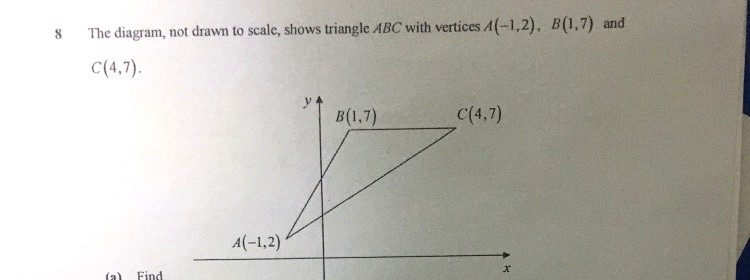
This is the diagram given
Date Posted:
6 years ago

Since E(4,k), E lies on the line x = 4.
Since the x-coordinate of C is also 4, C also lies somewhere on this line.
This means that CE is part of the line x = 4 and is parallel to the y-axis.
Take △ACE's base to be CE.
Area of △ ACE = ½ x base x perpendicular height
20 units² = ½ x CE x perpendicular distance from CE to A
40 units² = CE x (4 - (-1))units = CE x 5 units
(The perpendicular distance is obtained by finding the difference between the x-coordinate of A and 4, since x always = 4 on the line CE)
CE = 40 units² ÷ 5 units = 8 units
Now, E can be above C or below C.
So CE = k - 7 = 8
k = 7 + 8 = 15
Or
CE = 7 - k = 8
k = 7 - 8 = -1
∴ k = -1 or 15
Edited

 360 Tutoring Program