CH Wong's answer to Coco's Secondary 3 E Maths Singapore question.
done
{{ upvoteCount }} Upvotes
clear
{{ downvoteCount * -1 }} Downvotes

There you go
Date Posted:
6 years ago
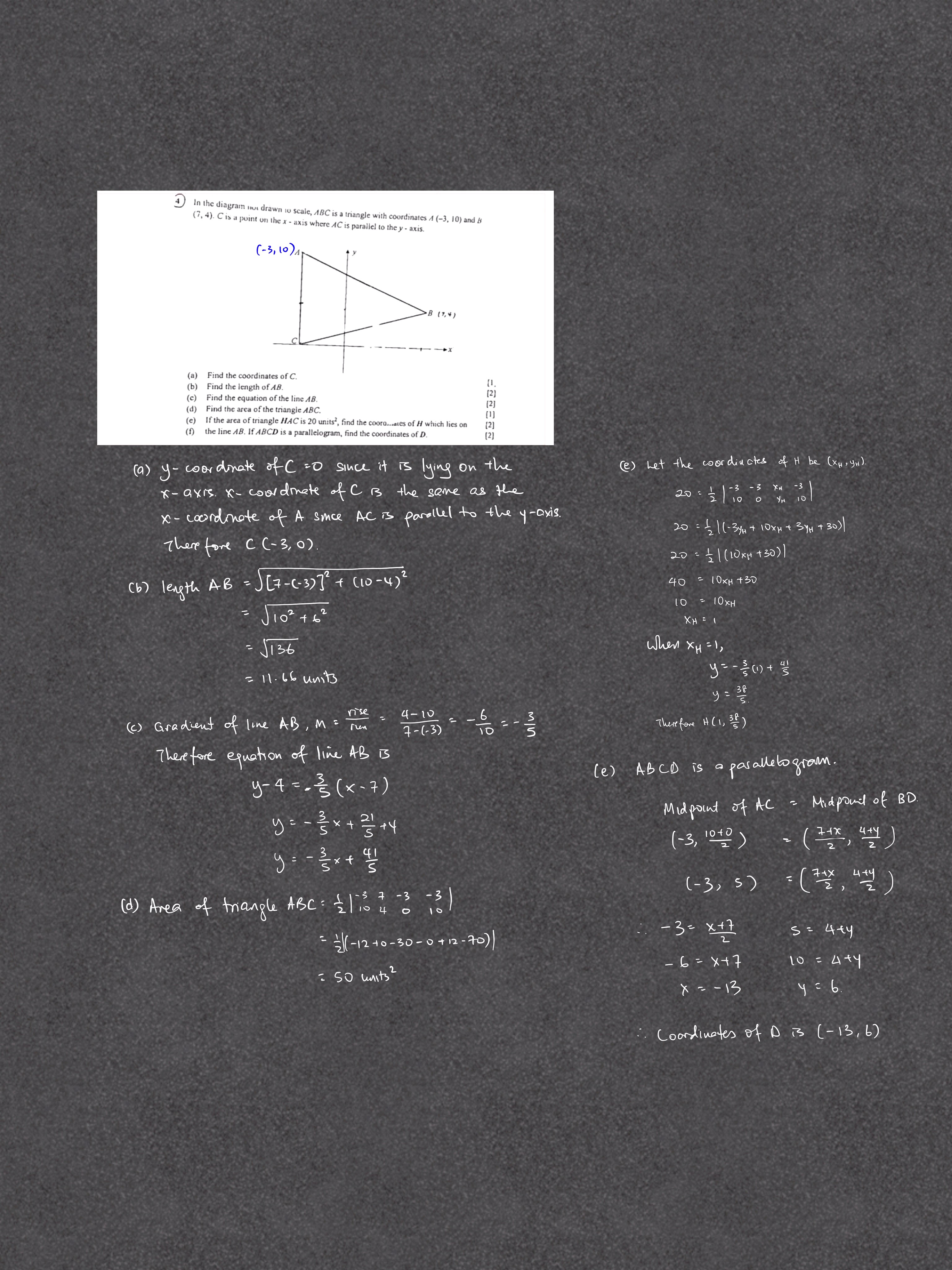
The shoelace method isn't taught in E Math, so for the area of △ ABC, we can just use the formula ½ x base x height since the base AC is parallel to the y-axis(and in turn perpendicular to the x-axis).
This also means the △ height can be taken to the length of the perpendicular from B to AC.
½ x (10 - 0) units x (7 - (-3)) units
= ½ x 10 units x 10 units
= 50 units²
This also means the △ height can be taken to the length of the perpendicular from B to AC.
½ x (10 - 0) units x (7 - (-3)) units
= ½ x 10 units x 10 units
= 50 units²
For e),
½ x base x height = 20 units²
So base x height = 40 units²
AC x length of perpendicular from AC to H = 40 units²
10 units x length of perpendicular = 40 units²
length of perpendicular = 40 units² ÷ 10 units = 4 units
x-coordinate of H = -3 + 4 = 1
Then sub x = 1 into equation of AB to find the y-coordinate

Thank you!

 360 Tutoring Program