Eric Nicholas K's answer to Nicole's Secondary 3 A Maths Singapore question.
done
{{ upvoteCount }} Upvotes
clear
{{ downvoteCount * -1 }} Downvotes

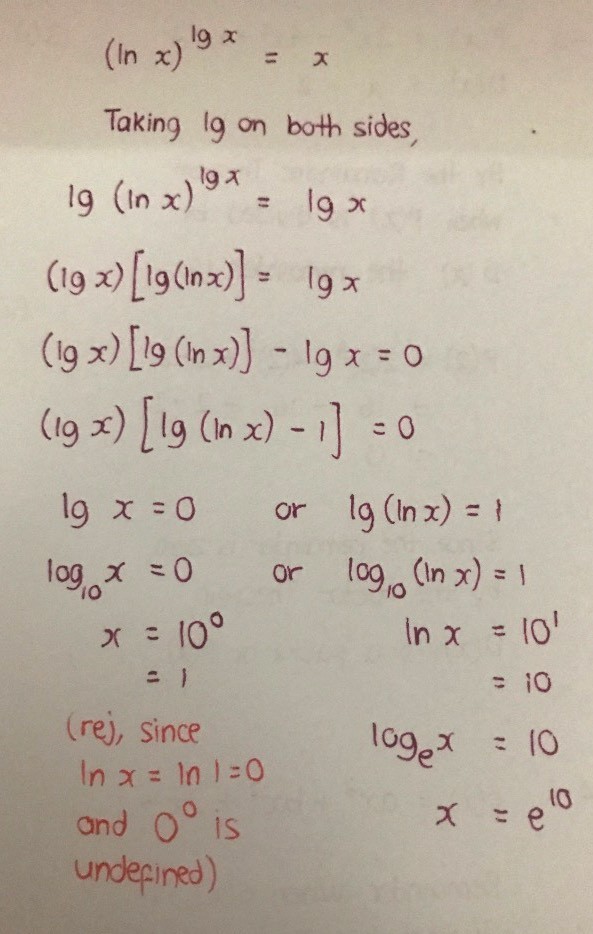
Note that we cannot bring down the power in the very first step as (ln x)^lg x is not the same as ln x^lg x.
Date Posted:
6 years ago

The reject part is quite subjective. For some syllabuses and textbooks, 0^0 is 1
I did think about it.
The way we evaluate a^0 is to take the division of a^n with a^n.
Taking 0^0 would result in a case of “zero divided by zero”.
I highly doubt that 0^0 is defined.
The way we evaluate a^0 is to take the division of a^n with a^n.
Taking 0^0 would result in a case of “zero divided by zero”.
I highly doubt that 0^0 is defined.
There are competing arguments for this.
For any number a,
a^a gets smaller and smaller as a gets smaller and goes below 1, but slowly starts to increase again.
5^5 = 3125
4^4 = 216
3^3 = 27
1^1 = 1
0.5^0.5 = 0.707106781
0.01^0.01 = 0.954992586
0.001^0.001 = 0.993116048
0.0001^0.0001= 0.99907939
0.00001^0.00001 = 0.999884877
And so on.
It makes sense as a→0, a^a →1
The mathematical world has no common consensus on this. I wonder what is Cambridge's stance for O levels
https://www.maa.org/book/export/html/116806 some arguments for 0^0 = 1, and how it should be defined in different context.
Well x^x does have a limit of 1 as x approaches zero if we do the LH rule, but then the value at zero exactly does not actually exist.
The O Levels don’t actually make mention of this though.
The O Levels don’t actually make mention of this though.
Whether it does exist or not is based in how people have defined The view for 0^0 for limits and calculus is generally taken to be indeterminate. For algebra and combinatorics it is mostly taken to be 1.
Just to be clear, 0^0 is indeterminate instead of undefined. There's a difference between the two.
Just to be clear, 0^0 is indeterminate instead of undefined. There's a difference between the two.

 360 Tutoring Program