Eric Nicholas K's answer to LockB's Secondary 3 A Maths Singapore question.
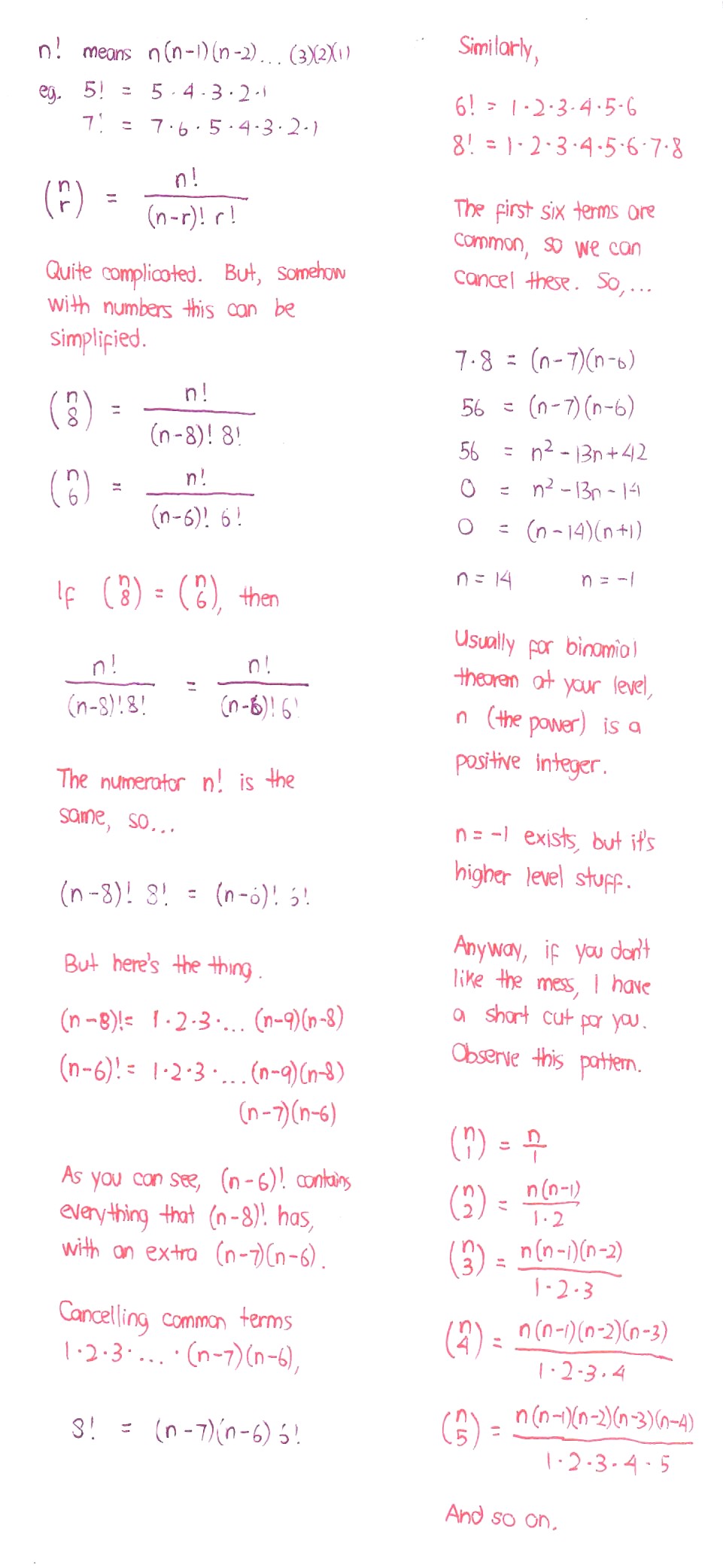
done
{{ upvoteCount }} Upvotes
clear
{{ downvoteCount * -1 }} Downvotes

An idea. You will only see the exclamation mark (called factorial) in this chapter.
Date Posted:
6 years ago

thx :)

n = -1 does not exist. Factorials have to be > 0
For example, if (-1)! exists,
and we know n(n-1)! = n!
Then we could write (0)(0 - 1)! = 0!
0(-1!) = 0!
0 = 1
(Since 0 x anything = 0 and 0! = 1)
This is a logical contradiction
For example, if (-1)! exists,
and we know n(n-1)! = n!
Then we could write (0)(0 - 1)! = 0!
0(-1!) = 0!
0 = 1
(Since 0 x anything = 0 and 0! = 1)
This is a logical contradiction
A useful tip :
① nCr = nC(n-r)
To see why :
nCr = n!/(n-r)!r!
nC(n-r) = n!/(n - (n-r))!(n-r)!
= n!/r!(n-r)!
= nCr
So once you see nC8 = nC6
you immediately know that n = 8 + 6 = 14
Another example: if nC23 = nC42
Then n = 23 + 42 = 65
① nCr = nC(n-r)
To see why :
nCr = n!/(n-r)!r!
nC(n-r) = n!/(n - (n-r))!(n-r)!
= n!/r!(n-r)!
= nCr
So once you see nC8 = nC6
you immediately know that n = 8 + 6 = 14
Another example: if nC23 = nC42
Then n = 23 + 42 = 65
By that I mean
(1 + x)^n
= 1 + nC1 x + nC2x^2 + nC3 x^3 + nC4 x^4 + ...
= 1 + nx + n (n - 1)/2 x^2 + n (n - 1) (n - 2)/6 x^3 + n (n - 1) (n - 2) (n - 3)/24 x^4 + ...
The second line is not valid for negative n since nCr is undefined for non-positive integers, but the third line still holds as usual.
(1 + x)^n
= 1 + nC1 x + nC2x^2 + nC3 x^3 + nC4 x^4 + ...
= 1 + nx + n (n - 1)/2 x^2 + n (n - 1) (n - 2)/6 x^3 + n (n - 1) (n - 2) (n - 3)/24 x^4 + ...
The second line is not valid for negative n since nCr is undefined for non-positive integers, but the third line still holds as usual.
Your second line is derived from the binomial expansion, where (a + b)ⁿ = aⁿ + nC1 aⁿ-¹ b + nC2 aⁿ-² b² + ... bⁿ, where n is a positive integer.
Set either b or a to 1 (and the other as x),
then bⁿ or aⁿ will be always positive 1 since n is positive (and not allowed to be negative)
So strictly speaking, if you equate this to your third line, then it can only hold for positive n
The third line is actually from the Maclaurin/Taylor expansion of (1 + x)ⁿ where n is allowed to be negative. Students should be careful not to conflate the two

 360 Tutoring Program