Eric Nicholas K's answer to LockB's Secondary 3 A Maths Singapore question.
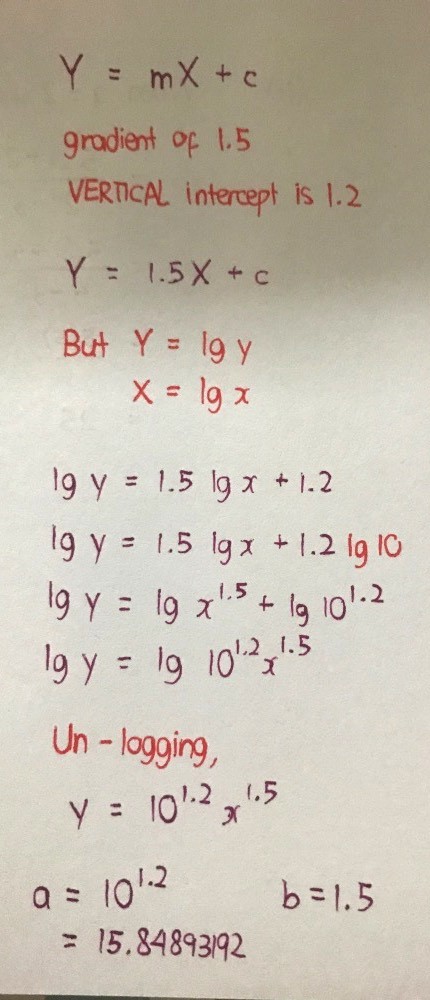
done
{{ upvoteCount }} Upvotes
clear
{{ downvoteCount * -1 }} Downvotes

An idea
Date Posted:
6 years ago

why do we need to add the log10 to 1.2 tho
I introduce the log in advance so that all the three expressions in the equation will be log. It’s an anticipatory move. So that I can remove all the logs at the same time.
Alternatively, there is no need to log the 1.2, and instead,
lg y = 1.5 lg x + 1.2
lg y - 1.5 lg x = 1.2
lg y - lg (x^1.5) = 1.2
lg (y / x^1.5) = 1.2
Converting to index,
y / x^1.5 = 10^1.2
y = 10^1.2 * x^1.5
Different schools teach differently. Personally I use my this typewritten one more often. My student’s school taught the one that I wrote in the photo.
So, in my working, the purpose of introducing a "multiplier" lg 10 (technically not a multiplier since lg 10 = 1, but I freely put it behind for the purpose) is to combine the logs later on.
It's similar to introducing terms when completing the square - you introduce to allow three of the terms to be factorised into a squared expression, leaving a constant term at the end.
You may find my other post easier to understand - that is, starting from the y = ax^b and then converting down to the form Y = mX + c.
thx :)

 360 Tutoring Program