Eric Nicholas K's answer to ☃️'s Secondary 4 A Maths Singapore question.
done
{{ upvoteCount }} Upvotes
clear
{{ downvoteCount * -1 }} Downvotes

Not so straightforward as to plot the x and V just like that, since this yields a cubic curve. And we can’t “straighten” a cubic curve to say it is a line.
So, we need to transform the equation into a suitable form Y = mX + c, subject to these rules.
- Y and X can only contain terms in V and/or x (this includes V/x, x^2, sqrt x, ln x etc but not x raised to the power of an unknown).
- m and c cannot contain terms in V or x at all.
So, two out the three terms should contain variables in V and/or x, while the third term cannot contain V or x at all.
Here, our expression
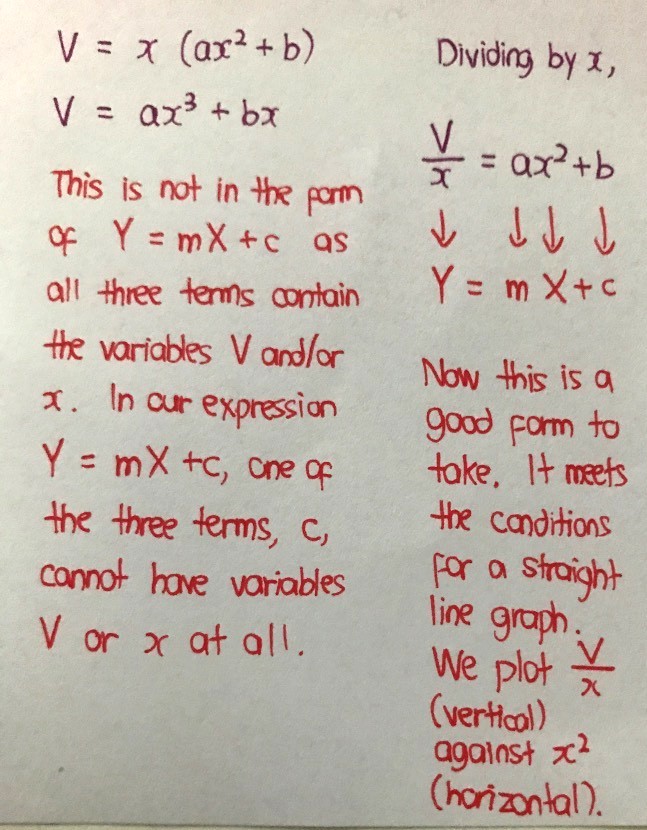
V = x (ax2 + b)
V = ax3 + bx
does not meet the criteria, since the first two terms V and ax3 meets the Y and mX condition, but the last term bx contains a variable when it is not supposed to be the case.
So, we need to do some transformations to the equation.
Because bx contains x, and we do not want the x, we can divide all sides by x to get
V/x = ax2 + b
Now if you inspect this one more time, yes it fits the condition. Because Y only contains a mix of variables V and/or x without anything else (here, V/x), m is our a, X contains a mix of variables V and/or x (here, x2) and c is our b.
This satisfies our linear graph condition, and hence we need to plot a graph of Y against X, or in this case, V/x (on the vertical) against x2 (on the horizontal). The gradient of our line is a and the vertical intercept of our line is b.
You need to tabulate values of x2 and V/x based on the given values of x and V, before being able to plot the data points on the graph paper.
Let me know if you need working for the rest.
Date Posted:
6 years ago

thank you very much! got it now! :D

 360 Tutoring Program