Eric Nicholas K's answer to ☃️'s Secondary 4 A Maths Singapore question.
done
{{ upvoteCount }} Upvotes
clear
{{ downvoteCount * -1 }} Downvotes

Third part
Date Posted:
6 years ago

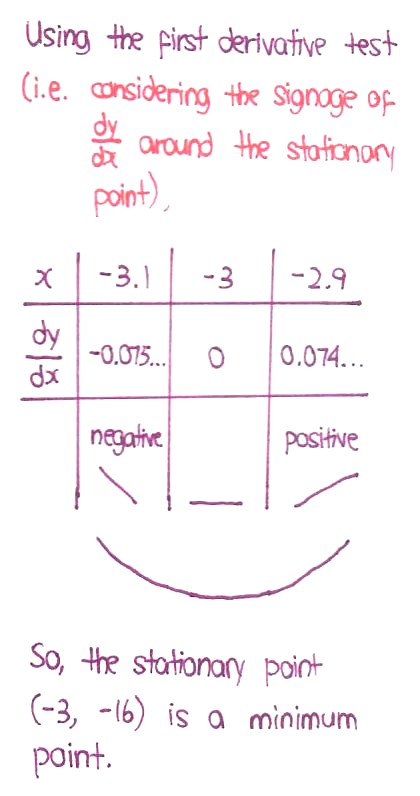
Got to be careful with the value of x here.
Sometimes choosing a certain value to the left or right of the stationary point would result in going past another stationary point (if they are very close) and may result in a wrong conclusion of the sign of dy/dx.
It is better to pick a value as close to the stationary point (x = -3) in this case eg. -3.000000001 and -2.999999999
Furthermore, leaving the values as 3- and -3+ instead of -3.1 and 2.9 would suffice. No need to state the exact value you use (just perform the calculation)
Here is probably ok (since in fact there are no stationary points apart from this one), so practically any value below -3 works perfectly fine.
For the syllabus, -3.1 or -3.01 should suffice. Maybe -3- is better.
For the syllabus, -3.1 or -3.01 should suffice. Maybe -3- is better.
Yup for this question is okay. The advice to the student is for such questions in general (to be safe)

 360 Tutoring Program