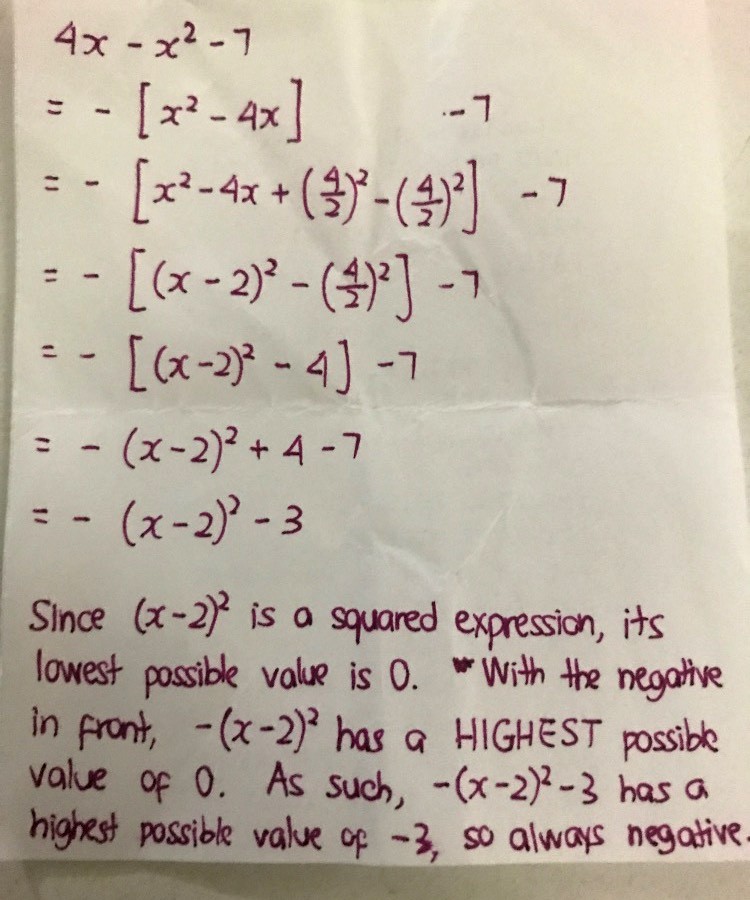
Eric Nicholas K's answer to Nicky's Secondary 3 A Maths Singapore question.
done
{{ upvoteCount }} Upvotes
clear
{{ downvoteCount * -1 }} Downvotes

We use a similar argument for this one. There is also another approach, by using discriminant of roots.
For the expression 4x - x^2 - 7, or to put it more nicely, -x^2 + 4x - 7,
Discriminant of roots
= 4^2 - 4 (-1) (-7)
= 16 - 28
= -12
< 0
meaning that the curve will never ever cut the x-axis. This means that the curve must be either always positive or always negative.
The difference between these two lies in the coefficient of x^2. In our expression, the coefficient of x^2 is -1, which is a negative number.
This is reflective of a “sad face” quadratic graph, which in conjunction with the negative discriminant of roots will generate a graph which is always below the x-axis (or always negative).
Date Posted:
6 years ago

 360 Tutoring Program