Eric Nicholas K's answer to tiffany tan's Secondary 3 A Maths Singapore question.
done
{{ upvoteCount }} Upvotes
clear
{{ downvoteCount * -1 }} Downvotes

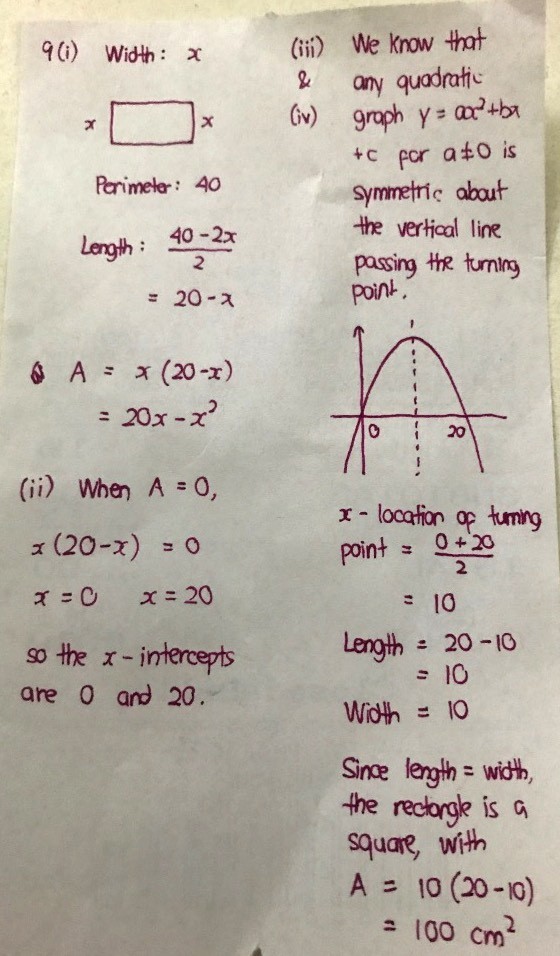
We consider the symmetry of a quadratic graph to solve this question.
In the case where there are two x-intercepts, the x-coordinate of the turning point is always the average value between the two x-intercepts. Nicely, this corresponds to the length and the width of the rectangle being equal, so that the shape concerned is a square.
To show that the area found is indeed a maximum (ie the turning point of the graph is a maximum point, or the graph is “sad face”), we simply note that the coefficient of x2 in our expression for A is a negative value (-1). As long as the coefficient of x2 is negative, we get a “sad face” curve, with a maximum point. Similarly, as long as the coefficient of x2 is positive, we get a “smiley face” curve, with a minimum point.
There is a Sec 4 A Maths technique for this question, which I will not use in the spirit of the “Sec 3 A Maths” tagging of this question.
Date Posted:
6 years ago

 360 Tutoring Program