Eric Nicholas K's answer to Russell's Secondary 3 A Maths Singapore question.
done
{{ upvoteCount }} Upvotes
clear
{{ downvoteCount * -1 }} Downvotes

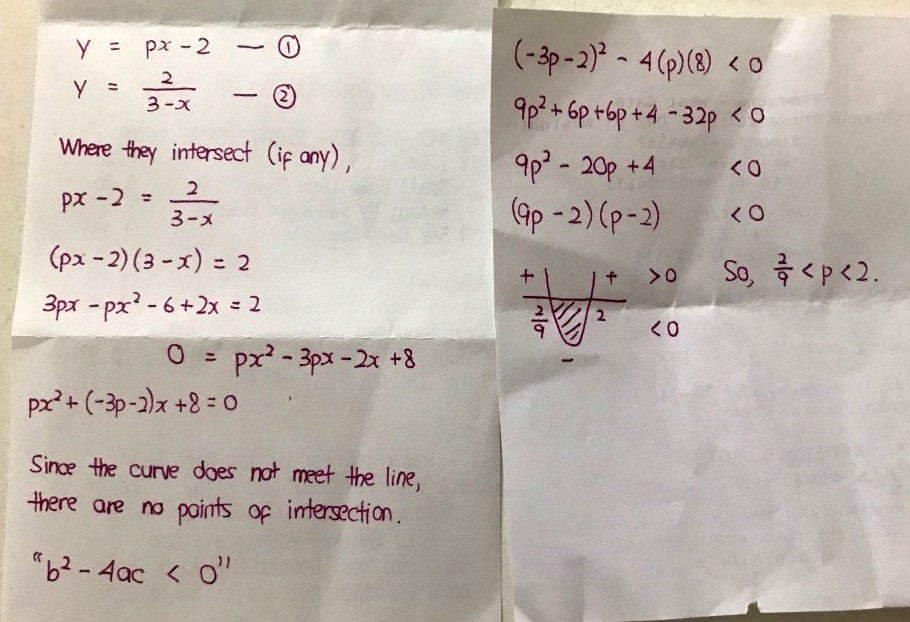
Even though the line does not actually intersect the curve, we pretend that they intersect first, so that we can perform a simul.
In reality, the simul here serves to indicate that both graphs are about to be plotted on the same axes.
In reality, the simul here serves to indicate that both graphs are about to be plotted on the same axes.
Date Posted:
6 years ago

How do you get from (9p-2)(p-2) to 2/9 < p < 2
To see this, you will need to understand the behaviour of quadratic graphs. They behave in a very different way from linear graphs.
Suppose you have an inequality x - 2 > 0. The contact limit is x = 2, and we can safely say that x > 2 because the line goes straight up and never ever returns. Ever.
For quadratic graphs, however, they behave differently.
(9x - 2) (x - 2) < 0
They behave differently from a linear graph. We cannot conclude that 9x - 2 < 0 and x - 2 < 0.
The original graph for this function is y = (9x - 2) (x - 2). This is a “smiley face“ graph. Their x-intercepts are at 2/9 and 2.
The graph will first come from a high point above the x-axis, coming down to cross the x-axis at x = 2/9 before continuing in the negative to a lowest point and then rebounding to cross the x-axis once again at x = 2 and never come down again.
As such, before the lower contact limit x = 2/9, the graph actually goes up above the x-axis! This is in stark contrast with our required region which must be below the x-axis.
By inspection, x must actually be more than 2/9, because this is the part of the graph which is below the x-axis. However, the “Cinderella story” of remaining below the x-axis ends when x = 2.
As such, our required solution for the inequality is 2/9 < x < 2.
Similarly, for inequalities such as (x + 2) (x - 2) < 0, our required solution is -2 < x < 2, while other inequalities such as (x + 3) (x - 1) > 0 will have solutions x < -3 or x > 1.
When we say an inequality is less than zero, it means that we are looking for regions below the x-axis. Similarly, when we say an inequality is higher than zero, it means that we are looking for regions above the x-axis. We then describe their range of x-values.

 360 Tutoring Program