Eric Nicholas K's answer to Candice lim's Secondary 3 A Maths Singapore question.
done
{{ upvoteCount }} Upvotes
clear
{{ downvoteCount * -1 }} Downvotes

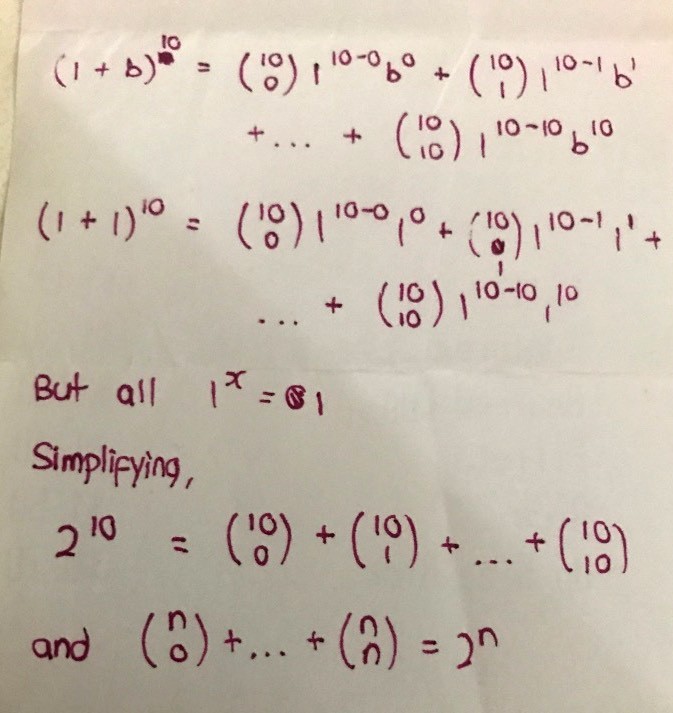
The easiest trick here is to consider (1 + x)^n followed by (1 + 1)^n. Let me know if you need more explanation.
Date Posted:
6 years ago
My choice of letting b = 1 comes because the binomial expansion itself is considered an identity which holds for all values of the unknown. By letting a = 1 and b = 1 in (a + b)^n, I am able to simplify the right hand side using the fact that 1 raised to the power of any number equals 1.

Hi Mr Eric, thank you so much for your prompt advice. Could you kindly explain part (i)'s solution to me?
The thing about this binomial expansion is that the coefficients of x (or a, b, ...)are found as (10 0), (10, 1) (10, 2) and so on up to (10 10) separated by pluses. However, there also exist other terms alongside the (10 10).
(a + b)^10
= (10 0) a10 b0 + (10 1) a9 b1 + (10 2) a8 b2 + ... + (10 10) a0 b10
We are required to obtain (10 0) + (10 1) + (10 2) + ... + (10 10) without calculating individual values.
This looks like the expansion above. Wouldn’t it be nice if the expansion were to be the same as our required sum? The inspiration comes at this stage.
The thing is, the expansion can be treated as some form of identity which holds true for all values of a and b. If somehow we could make a and b disappear, then we would obtain our required sum!
Voila! And there you are! All we need to do is to set a and b as 1, because 1 raised to any power yields 1 and a number will not be affected by a multiplication with 1.
Hence, letting a = 1, b = 1, we have
(1 + 1)^10
= (10 0) 1^10 1^0 + (10 1) 1^9 1^1 + ... + (10 10) 1^0 1^10
= (10 0) + (10 1) + ... + (10 10)
The left hand side simplifies to 2^10 having a value of 1024, while the right hand side simplifies to our required sum!
Hence, the sum (10 0) + (10 1) + ... + (10 10) equals 1024.
Part b is just an extension of part a for any generalised positive integral powers n.
Yes, I got it :) Awesome explanation. Thank you so much for your effort, time and patience in clarifying my doubts.

 360 Tutoring Program