AC Lim's answer to Ria's Secondary 3 E Maths Singapore question.
done
{{ upvoteCount }} Upvotes
clear
{{ downvoteCount * -1 }} Downvotes

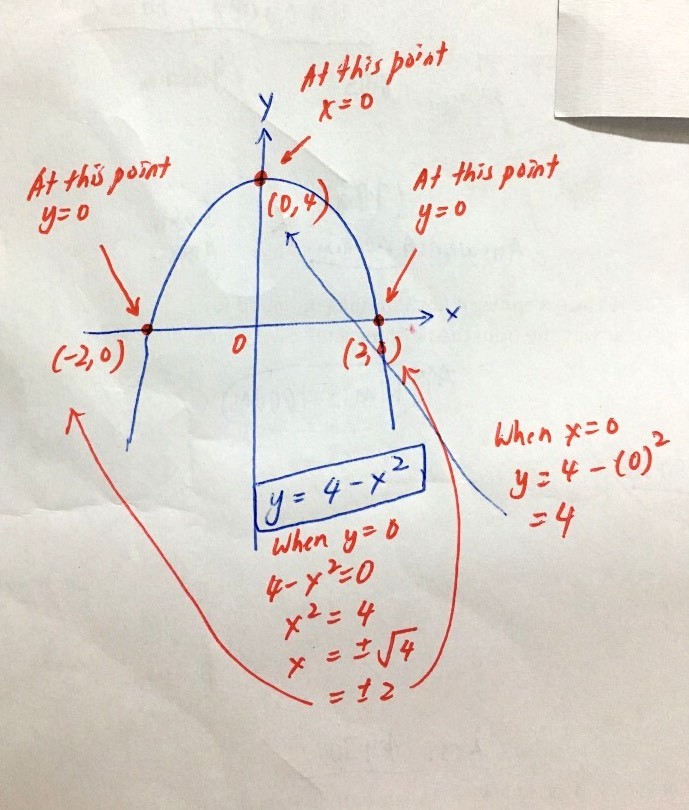
When point cross x-axis, y=0. When curve cross y-axis, x= 0. By substitutes x = 0, you will get the y value which curve cross the y-axis.
Hope this helps
Hope this helps
Date Posted:
6 years ago

Ria, these are purely my personal experiences and observations.
For a graph y = ax2 + bx + c, where a is not zero, the graphs would satisfy the following.
1. If a is positive, all the graphs will be smiley face shaped. If a is negative, all the graphs will be sad face shaped. So for example, y = x2 - 5x - 9 will be smiley face, while y = 7 - 3x - x2 will be sad face.
2. The value of c determines whether the graph passes through the y-axis above, on or below the x-axis. So for example, y = x2 - 5x - 9 will cut the y-axis below the y-axis, since c is negative, while y = 7 - 3x - x2 will cut the y-axis above the x-axis, since c is positive.
3. If b is zero, the turning point lies along the y-axis, and their x-intercepts (if any) will be equally far from the y-axis. For example, y = x2 - 4 will have a turning point at (0, -4) and their x-intercepts are (-2, 0) and (2, 0). If a and b are of opposite signs, the turning point will lie to the right of the y-axis (ie have a positive x value). If a and b are of the same signs, the turning point will lie to the left of the y-axis (ie have a negative x value). So for example, y = x2 - 5x - 9 will have a turning point when x = 2.5, while y = 7 - 3x - x2 will have a turning point when x = -1.5.
A good way to approach quadratic graphs is to see the shape (smiley or sad) and where their x-intercepts are (if any) by letting y = 0 and solving for x and where their y-intercepts are by letting x = 0 and solving for y.

Thank u for ur time and effort really help but may I know what can I do if the equations is 3+2x-x^2? How am I supposed to sub in the 0 when there r 2 Xs? I tried subbing in for both the x it turns out to be 5 but that’s impossible pls enlighten me
y = 3 + 2x - x^2
Now, we are not sure if the graph will cut the x-axis. Regardless, we will still proceed to find them as though they exist.
At the point(s) where the graph crosses the x-axis (if any),
y = 0 (this is an important property for points lying along the x-axis)
When y = 0,
y = 3 + 2x - x^2 (the entire graph)
0 = 3 + 2x - x^2 (only for selected points)
Bringing over to the other side,
x^2 - 2x - 3 = 0
Factorising using cross factorisation (or any other suitable method),
(x - 3) (x + 1) = 0
This means that
x - 3 = 0 or x + 1 = 0
x = 3 or x = -1
So the points where the graph crosses the x-axis are when x = -1 and when x = 3. The graph is a sad face graph, so you can imagine a graph going upwards to cut the x-axis at x = -1, then hit a maximum point somewhere, then goes down, cuts the x-axis again at x = 3 and goes down forever.
As a bonus, a nice thing about such graphs is that they are symmetrical. If the graphs cut the x-axis at -1 and 3, then the x coordinate of the turning point is exactly halfway between these two values, or in other words, x = 1.
The equation is 3+2x-x to the power of 2 not -2x
Oh my apologies, my notation for x^2 is x2. I use 2x for 2 multiplied by x.
Updated with x^2 instead of x2 for clarity.
Updated with x^2 instead of x2 for clarity.

 360 Tutoring Program