Eric Nicholas K's answer to Noel's Junior College 2 H3 Maths Singapore question.
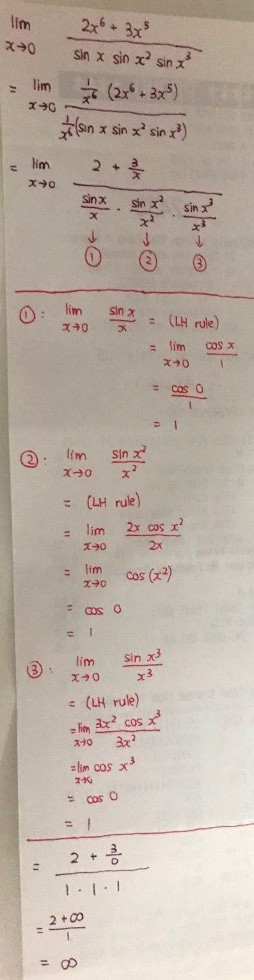
done
{{ upvoteCount }} Upvotes
clear
{{ downvoteCount * -1 }} Downvotes

Not 100% sure about this.
Date Posted:
7 years ago
I plotted the graph on Desmos and saw that the limit from 0- goes to negative infinity while the limit from 0+ goes to positive infinity.

hi thanks for your help! just want to clarify, for your last part where you put 3/0, can we actually write that and conclude that equals to infinity because mathematically I thought we are not supposed to arrive at something divided by zero?
Technically it’s safer to skip the 3/0 part and just write infinity immediately, but I wrote it there for clarification to see why it goes to infinity.
Hi sorry to disturb again, if both side limits are different, then shouldn't the limit not exist? Then how do I go about showing that it doesn't exist?
I had wondered about this for a moment the day before and could not reach a decision on this; I had to plot the graph to convince myself that the limit on one side is negative infinity while the limit on the other side is positive infinity.
Once you get to the “2 + 3/x” part, it gets tough from here. Yes, it is true by one look that this gets you negative from one side and positive from the other side. Technically when the limits are not the same from both sides, the limit should not exist, which you are spot on.
But the way the question was phrased “find the limit...” suggests that a limit does exist, so I have no choice but to follow the wordings.
I’m afraid you may have to check with your teacher/tutor/instructor/lecturer on this, but perhaps the limit really does not exist after all.
Oh I see, maybe the question was not phrased clearly, what if the question asked to find the limit if it exists, else prove that it doesn't?
I would have put no limit in that instance. The limits must be approached from both sides to the same value (excluding infinity) for continuities.

 360 Tutoring Program