Eric Nicholas K's answer to Angeline Wong's Secondary 3 A Maths Singapore question.
done
{{ upvoteCount }} Upvotes
clear
{{ downvoteCount * -1 }} Downvotes

This gets a little difficult to explain.
For such questions, we are asked to find out the remainder when divided by a quadratic divisor of degree 2. We will expect the remainder to have a degree which is at most one degree lower than the divisor, which in this case is at most degree 1.
We formulate an equation in the form
Dividend = divisor x quotient + remainder
and in this case,
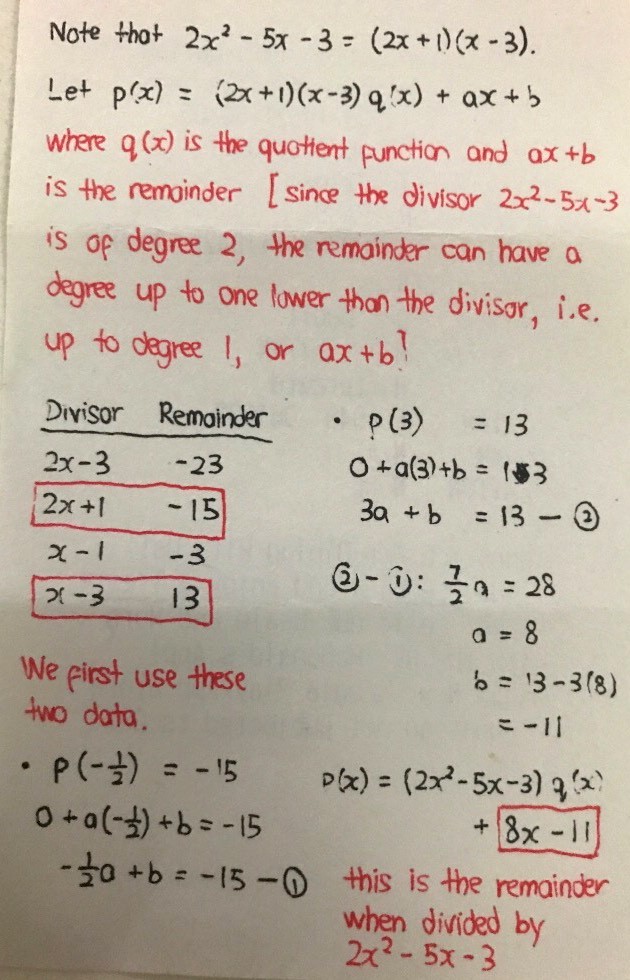
P(x) = (2x2 - 5x - 3) q(x) + (ax + b) where P(x) is the dividend, (2x2 - 5x - 3) is the divisor, q(x) is the quotient function (which we will eventually not find, since it can be of any degree) and ax + b is the remainder of degree 1. We formulate it in such a manner because we are asked to find the remainder when P(x) is divided by the divisor 2x2 - 5x - 3, which simply gives the remainder ax + b. We work out the values of a and b using some of the data provided.
Note that 2x2 - 5x - 3 = (2x + 1) (x - 3), so we can use the informations with 2x + 1 and x - 3, because the corresponding choices of x (which are -1/2 and 3) will kill off the unknown q(x) expression in the (2x + 1) (x - 3) q(x) expression, since we would have made either 2x + 1 or x - 3 equal to 0 and 0 multiplied by q(x) is 0. This is important because q(x) can be any expression.
With the two information above, we obtain two equations in a and b and solve for them.
Finally, the remainder is ax + b using out found values of a and b.
Let me know if you need more explanation.
Date Posted:
7 years ago

 360 Tutoring Program