Eric Nicholas K's answer to claris's Secondary 2 Maths Singapore question.
done
{{ upvoteCount }} Upvotes
clear
{{ downvoteCount * -1 }} Downvotes

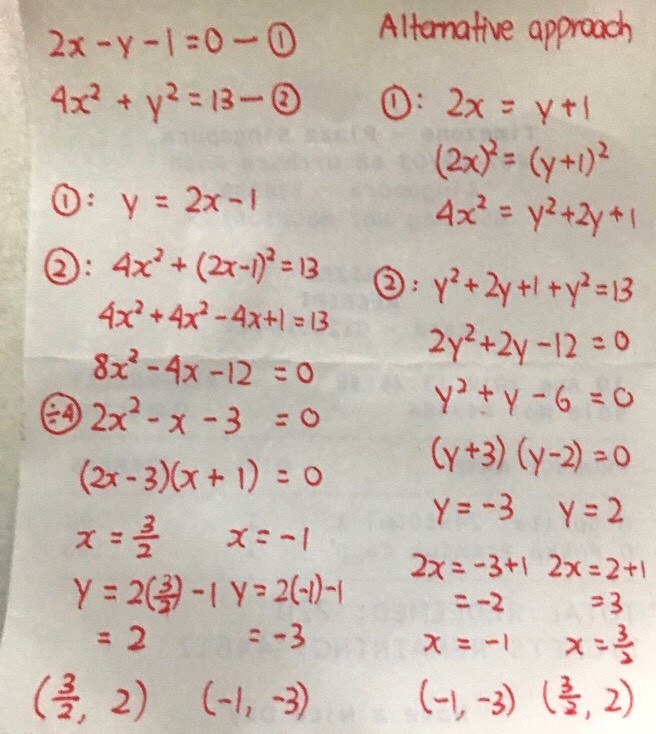
The first method by substitution is commonly used for such simultaneous equations involving one linear equation and one non linear equation.
I am surprised this question is in Sec 2 Maths when it should be in Sec 3 A Maths.
Date Posted:
7 years ago

i do not get the (2x-1)^2 part. Where did you get the -4x from?
The two equations to consider are
2x - y - 1 = 0
4x^2 + y^2 = 13
We solve the equations simultaneously to obtain the values of x and y. There will be two pairs of coordinates, P and Q, for this.
Rearranging the first equation, we obtain
y = 2x - 1 (Equation 1)
We would need to substitute this expression of y into the second equation to obtain an equation involving x only. In other words, we need to replace all the “y” in the second equation by “2x - 1”.
4x^2 + (2x - 1)^2 = 13
If you are not confident of expanding (2x - 1)^2 using the special expansion (a - b)^2 = a^2 - 2ab + b^2, we can expand them manually to see why there is a - 4x term in the middle.
(2x - 1)^2
= (2x - 1) (2x - 1)
= 2x (2x - 1) - 1 (2x - 1)
= 4x^2 - 2x - (2x - 1)
= 4x^2 - 2x - 2x + 1
= 4x^2 - 4x + 1
which is where the - 4x comes from.
Common mistakes at the Secondary 2 level (since you all just learnt the expansions earlier this year, but this issue is also prevalent in Secondary 3 and Secondary 4 students as well, so you must remember to avoid them) are to write
(2x - 1)^2
as (2x)^2 - 1^2 or
as (2x)^2 + 1^2
thereby missing out on the middle term. You can also use numbers for x to check the validity of the numbers.
When x = 8,
(2x - 1)^2
= (2 x 8 - 1)^2
= (16 - 1)^2
= 15^2
= 225
and
4x^2 - 4x + 1
= 4 x 8 x 8 - 4 x 8 + 1
= 256 - 32 + 1
= 225
The middle term - 4x, as we can see, is important here.
Using the correct expansion, we obtain
4x^2 + (4x^2 - 4x + 1) = 13
4x^2 + 4x^2 - 4x + 1 = 13
8x^2 - 4x + 1 = 13
8x^2 - 4x + 1 - 13 = 0
8x^2 - 4x - 12 = 0
Dividing both sides of the equation by 4,
2x^2 - x - 3 = 0
You can use cross factorisation techniques or what you have learnt to factorise the quadratic equation. Do not bring the 3 over to the other side and attempt to factorise the other two terms! This is also a common mistake amongst students, by leaving the other side as non-zero when the other side must actually be made zero.
(2x - 3) (x + 1) = 0
We can say that
2x - 3 = 0 OR x + 1 = 0
(it’s OR, not AND)
since setting one of them to zero at any one time will make the whole expression becomes zero regardless of the value of the other bracket (0 multiplied by any real number equals 0).
2x = 3 OR x = -1
x = 3/2 OR x = -1
When x = 3/2,
y = 2x - 1
= 2 (3/2) - 1
= 3 - 1
= 2
This gives you one coordinate (3/2, 2).
When x = -1,
y = 2x - 1
= 2 (-1) - 1
= -2 - 1
= -3
This gives you another coordinate (-1, 3).
Since it is not specified which must be P and which must be Q, you can label them either way.
I am surprised that this question belongs to a Secondary 2 Maths question since Secondary 2 students are only taught to solve two simultaneous linear equations in two variables, whereas this question involves one linear equation and one non-linear equation.
ok i get it now thank you
is this qn also similar to that?
a) solve the equation 4x(x-11)=x
b) Hence, find the solution(s) or the equation 4(y-1)(y-12)=(y-1)
4x (x - 11) = x
Here it’s slightly different, there are no hidden terms unlike in the other case when the expansion of the square releases the middle term as well. Also, we are solving the two equations separately.
We expand the brackets to obtain
4x^2 - 44x = x
Be warned. A common mistake is to divide both sides by x, even though all terms do contain at least one x. This technique will lose one solution x = 0.
The correct technique is to make one side of the equation zero.
4x^2 - 44x - x = 0
4x^2 - 45x = 0
x (4x - 45) = 0
x = 0 or 4x - 45 = 0
x = 0 or 4x = 45
x = 0 or x = 45/4
For the second part, the relevant equation is
4 (y - 1) (y - 12) = y - 1
With the ‘hence’ stipulation, we are not allowed to expand out the brackets and solve the new equation. This ‘hence’ stipulation requires us to use the results from the first equation to solve this new equation.
Upon close inspection, by letting x = y - 1 (or equivalently y = x + 1), the above equation becomes
4 (x) (x + 1 - 12) = (x)
4x (x - 11) = x
which is exactly the first equation with solutions
x = 0 or x = 45/4
Hence, for the equation in y, we obtain
y - 1 = 0 or y - 1 = 45/4
y = 1 or y = 49/4
tysm !!!

 360 Tutoring Program