Eric Nicholas K's answer to universe's Secondary 3 A Maths Singapore question.
done
{{ upvoteCount }} Upvotes
clear
{{ downvoteCount * -1 }} Downvotes

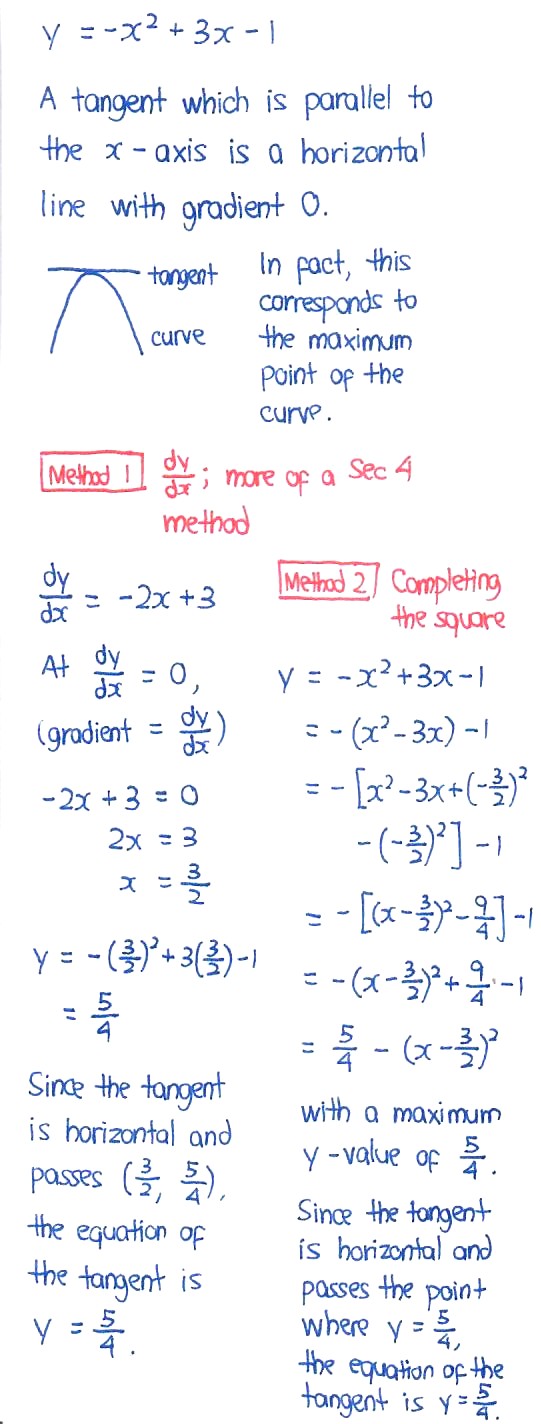
I have included two methods for this. One of it is a Sec 4 A Maths method by differentiation, and the other is a Sec 3 A/E Maths method by completing the square; I put both inside in case you have not learnt differentiation yet because it is actually a Sec 4 A Maths topic.
Basically, a tangent is a straight line which comes into contact with the curve only once ("touches" the curve), never twice or never misses the curve. This will be seen again in both E Maths and A Maths if you have not seen them yet.
A line which is parallel to the horizontal x-axis must be also horizontal, so the tangent must be horizontal (and therefore have a gradient of zero, since horizontal lines have gradients of zero).
The only point on a quadratic curve which exhibit this property is the turning point of the quadratic curve (either a maximum point or a minimum point, depending on the signage of the coefficient of x2).
Here the coefficient of x2 is -1 which is negative, so the turning point exhibited by the curve is a maximum point. We therefore need to locate the coordinates of the maximum point of the curve (or at least the y-coordinate, since the x-coordinate is not exactly required here).
Depending on your preference and what you have learnt, you may use either method to locate the coordinates of the maximum point.
The tangent is a horizontal line passing through this maximum point, so the equation of the tangent must be y = k where k is the y-coordinate of the maximum point.
Date Posted:
7 years ago

 360 Tutoring Program