Eric Nicholas K's answer to Batrisya's Secondary 2 Maths Singapore question.
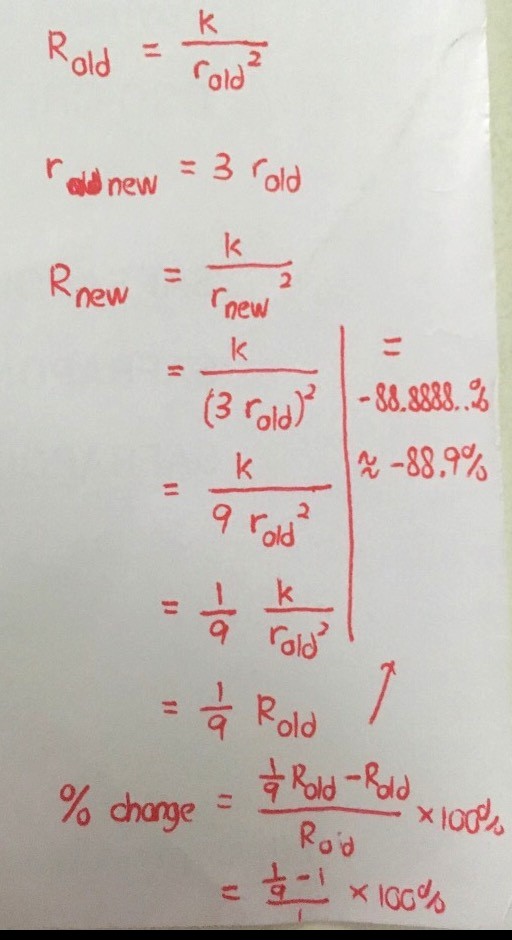
done
{{ upvoteCount }} Upvotes
clear
{{ downvoteCount * -1 }} Downvotes

This type of proportion question gets very difficult to solve without actual numbers for R and r. Let me know if you need more explanation for this.
Date Posted:
7 years ago

Im still unsure how 1/9 k/r old^2 = 1/9 r old, could you explain? thanks
WIll explain later. My phone currently very Low battery.
The old value of r is now tripled to become 3r. However, in doing so, the 'r' in r and in 3r remains the same, right?
(For example, 6 is tripled to become 3 x 6 = 18, but '6' remains unchanged).
Now, upon simplification, we get new R = k divided by (9 times the square of old r), which we factor out the 1/9.
As mentioned earlier, the 'r' has not changed. The proportionality constant k has not changed. Therefore, k divided by (old r)^2 remains "old R".
Sorry for the late reply, my phone malfunctioned yesterday and I forgot to reply last night.
Using numbers is probably much easier to observe here.
Let's say R = 9 and r = 1. After calculation, k = 9.
So R = 9/r2.
If r triples, r becomes 1 x 3 = 3. So the new value of R is 9/(3^2) = 9/9 = 1.
Old R is 9. New R is 1.
So percentage change is (new - old) / old x 100% = (1 - 9) / 9 x 100% = -8/9 x 100% = -88.88888...%.
I think I understand better now, thks!!

 360 Tutoring Program