Eric Nicholas K's answer to LIONEL LIM's Secondary 3 E Maths Singapore question.
done
{{ upvoteCount }} Upvotes
clear
{{ downvoteCount * -1 }} Downvotes

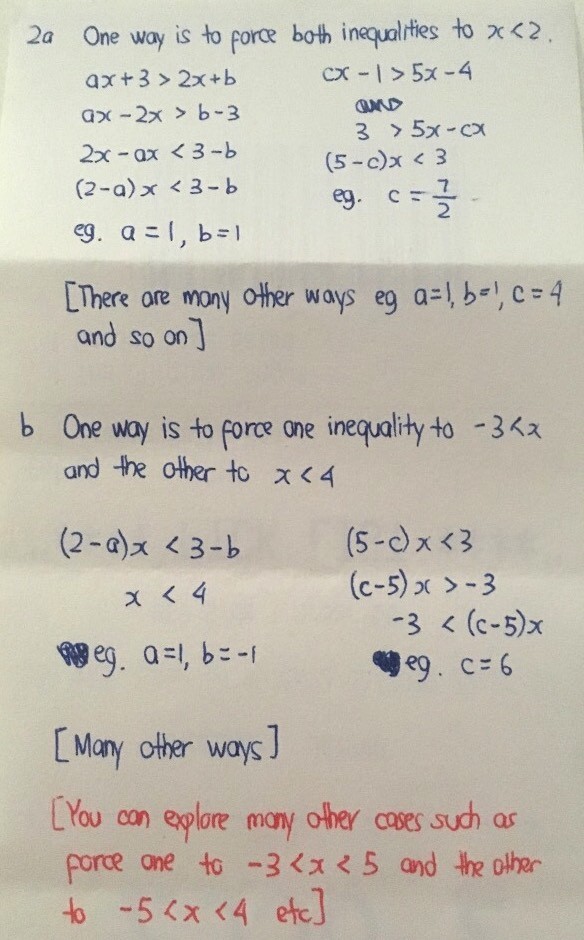
The question only asks for ‘a’ set of values, not ‘the’ set of values, so we can set our own final conditions for the inequalities which combine to form (a) x < 2 and (b) -3 < x < 4. From there we work out some values.
There are infinitely many answers to this question.
There are infinitely many answers to this question.
Date Posted:
7 years ago
For part a, the most straighforward way is to force both inequalities to x < 2, since their overlapping regions are also x < 2.
Notwishstanding this easy choice, you can also explore other options, such as force one inequality to x < 2 and the other to x < (a number larger than 2) since their overlapping regions are x < 2.
Similar argument applies for part b.
Notwishstanding this easy choice, you can also explore other options, such as force one inequality to x < 2 and the other to x < (a number larger than 2) since their overlapping regions are x < 2.
Similar argument applies for part b.

Hey Eric! Thanks for helping! But can i check, because the qn is asking for integer. For part (a) the value of C is 7/2, not an integer?
Oh, right. You can then force the other inequality into something else. For example, c = 4 fits nicely into the question.

 360 Tutoring Program