Eric Nicholas K's answer to nabilahh's Secondary 3 A Maths Singapore question.
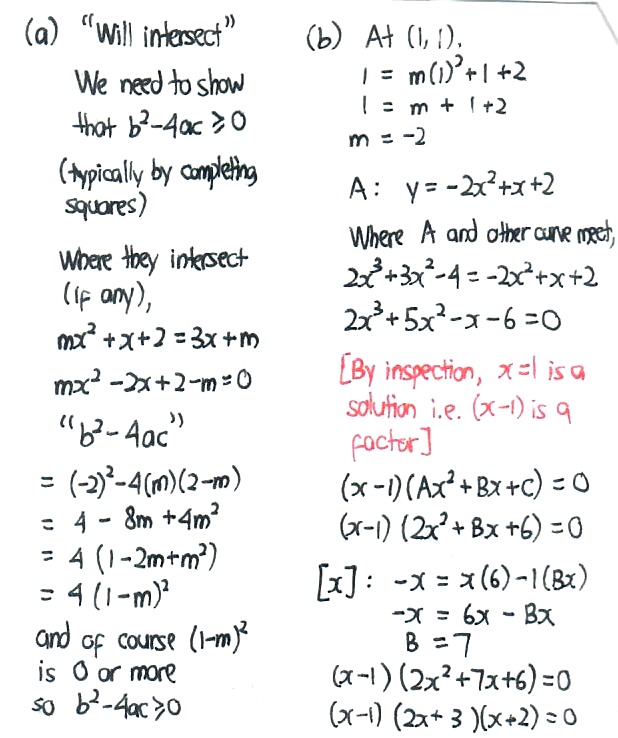
done
{{ upvoteCount }} Upvotes
clear
{{ downvoteCount * -1 }} Downvotes

Ran out of paper space so I will type the rest here.
(x - 1) (2x + 3) (x + 2) = 0
x = 1
y = 2 (1)^3 + 3 (1)^2 - 4
y = 1
so (1, 1) is one point of intersection
x = -1.5
y = 2 (-1.5)^3 + 3 (-1.5)^2 - 4
y = -4
so (-1.5, -4) is another point of intersection
x = -2
y = 2 (-2)^3 + 3 (-2)^2 - 4
y = -8
so (-2, -8) is yet another point of intersection.
------------------------------------------------------------
Now, in (a), we need to show that b2 - 4ac >= 0 since they intersect (if they never ever intersect, then there will never be solutions or roots, so b2 - 4ac < 0).
In (b), we need to obtain the value of m and then solve a pair of simultaneous equations in two variables x and y which eventually transforms into a cubic equation.
I assume that you are able to solve a cubic equation on your own so I won't go into the details here.
Date Posted:
7 years ago

 360 Tutoring Program