Eric Nicholas K's answer to Shams's Secondary 2 Maths Singapore question.
done
{{ upvoteCount }} Upvotes
clear
{{ downvoteCount * -1 }} Downvotes

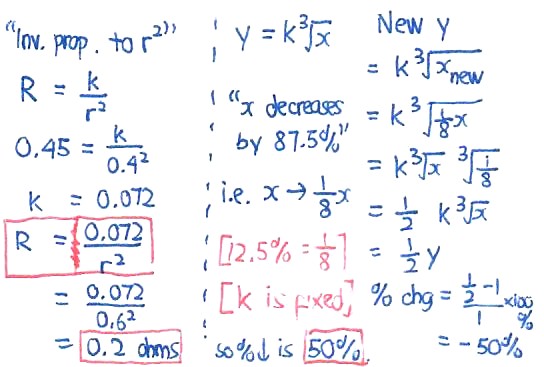
Part (b) is much more challenging than part (a).
Now, if x decreases by 87.5%, then the new x is 12.5% of the old x, so x has changed to 0.125x (0.125 = 1/8). If you are unsure, you can try x = 16 and then a reduction by 87.5% leads to new x = 2.
But the value of 'x' in x and in 0.125x is the same.
For any value y and x, y = k times cuberoot (x) The expressions y and x are allowed to change, but the expression k is fixed.
Since the new x is 0.125x,
New y = k times cuberoot (new x)
= k times cuberoot (0.125x)
= k times cuberoot (0.125) times cuberoot (x)
= cuberoot (0.125) times k times cuberoot (x)
= 0.5 times (k times cuberoot (x))
But remember that k times cuberoot (x) = y. The y here refers to the old value of y.
So new y = 0.5 times old y.
From y to 0.5y, the percentage decrease is 50%.
Date Posted:
7 years ago

 360 Tutoring Program