Daniel Poon's answer to Janice's Primary 6 Maths Geometry Singapore question.
done
{{ upvoteCount }} Upvotes
clear
{{ downvoteCount * -1 }} Downvotes

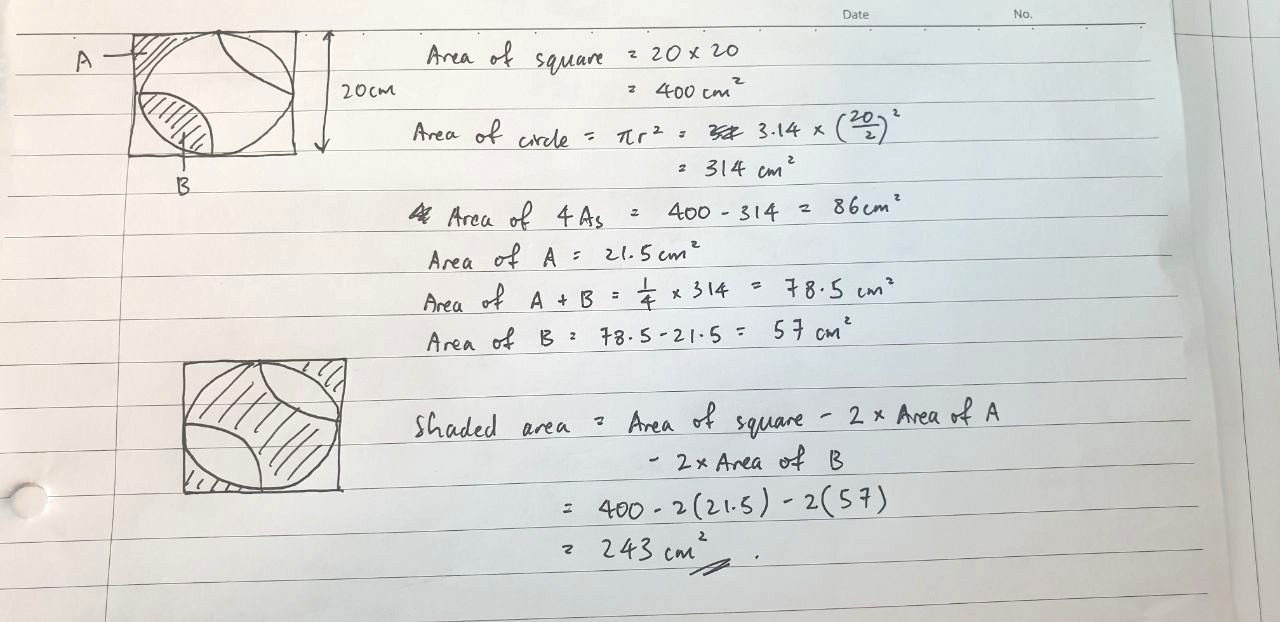
This question may seem tricky at first. The trick here is to look at the shapes carefully and you will realise that you can find the area of the unshaded region.
In my solution, I labelled the corners of the square not overlapped by the circle as A, and the region overlapping between the quadrant and the circle as B. You can find the area of A by subtracting the area of the circle from the area of the square, and then dividing the result by 4 (remember, there are 4 corners in the square!).
The area of each quadrant is 1/4 the area of the circle since the quadrant is similar to the circle. Therefore you can find B by subtracting A from the area of the quadrant. The shaded region can then be found by subtracting the area of the unshaded region from the area of the square.
Date Posted:
4 years ago

Tysm

 360 Tutoring Program