Eric Nicholas K's answer to LockB's Secondary 4 A Maths Singapore question.
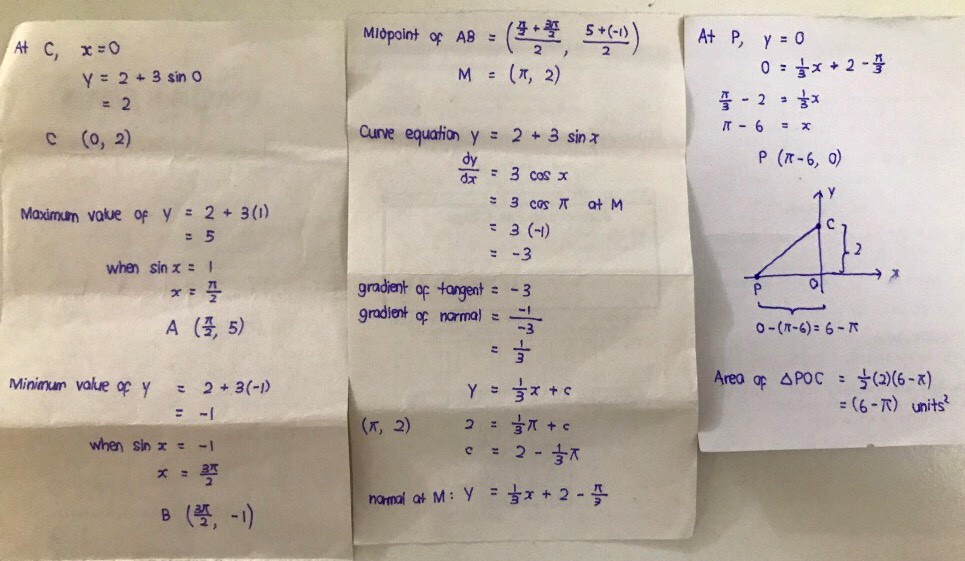
done
{{ upvoteCount }} Upvotes
clear
{{ downvoteCount * -1 }} Downvotes
Rough idea, but you need to combine the ideas of coordinate geometry and calculus
Date Posted:
5 years ago

for max and min point of a trigonometric sine/cosine graph, we can make use of 1<=sin/cos<=-1?
why must PO be 0-(pi-6) and cannot be pi-6, the x coordinate of P?
Max and min you can use the -1 to 1 because this is a simple function y = a sin bx + c
For things like y = x sin x, we have to use differentiation
It’s 6 - pi because 6 - pi is positive but pi - 6 is negative (lengths must be positive)
For things like y = x sin x, we have to use differentiation
It’s 6 - pi because 6 - pi is positive but pi - 6 is negative (lengths must be positive)
thx :)
does electrolysis of molten ionic compounds always take place in high temperature to ensure than the ionic compound electrolyte stays in molten state? or can it also take place in rtp?
for electrolysis of molten ionic compounds, will the product of the cation reactions at cathode also be at molten state or it will be at solid state (eg na^+ (l) +e^- = na(s) / na(l))
Of course you can’t have molten ionic compound at rtp in the first place because ionic compounds have high melting points to begin with, so the temperature must be high.
For the electrolysis of molten compound formed, it depends on the physical state of the resulting metal obtained.
For the electrolysis of molten compound formed, it depends on the physical state of the resulting metal obtained.
thx :)
why can o2 burn graphite electrodes at high temperature to form co2 when graphite is an inert electrode that cant react with anything?
why can o2 burn graphite electrodes at high temperature to form co2 when graphite is an inert electrode that cant react with anything?
It’s made of carbon after all.
Inert simply denotes the fact that something is generally unreactive under regular conditions. It does not mean that it will never react with anything. The extremely high temperature is definitely not a regular condition - it’s an extreme.
At higher levels, you might learn that even group 0 elements like neon and xenon are capable of reacting with other elements.
there's a qn that i've seen twice but i do not understand the answer...
"some drink cans are made from iron electroplated with aluminium. aluminium is a more reactive metal than iron. if the aluminium coating is scratched, would you expect the iron layer to rust? explain your answer"
why is the answer no when the aluminium coating is already scratched off? if the coating is scratched off, this means that there will not be any coating left and the iron will be exposed to the air to rust
Even though it’s scratched, there is still too much aluminium surrounding the scratch that the aluminium will still be hit instead of the exposed layer of the scratch.
We assume the scratch is not a significant one.
We assume the scratch is not a significant one.

 360 Tutoring Program