sunlight's answer to sunlight's Secondary 3 A Maths Singapore question.
done
{{ upvoteCount }} Upvotes
clear
{{ downvoteCount * -1 }} Downvotes

Sorry about the quality just now
Date Posted:
5 years ago
Idk if the a is more than 1 or not so dk how to plot the graph and do the qns

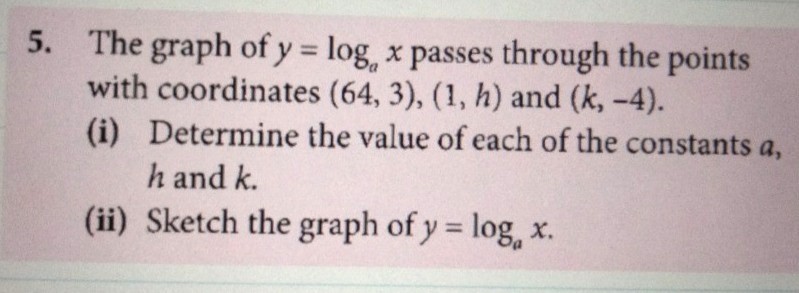
Sub (64,3) into the equation first.
3 = loga 64
So a³ = 64
(You basically bring the 3 up into the index position and a is the base)
a³ = 4³
a = 4
3 = loga 64
So a³ = 64
(You basically bring the 3 up into the index position and a is the base)
a³ = 4³
a = 4
Then, sub (1,h) and a = 4 into the equation.
h = log4 1
h = 0
log(any valid base) 1 is always 0
To see why, observe the following :
h = log4 1
4^h = 1
h must be 0 such that 4^0 = 1
h = log4 1
h = 0
log(any valid base) 1 is always 0
To see why, observe the following :
h = log4 1
4^h = 1
h must be 0 such that 4^0 = 1
Sub (k-,4) and a = 4 ,
-4 = log4 k
k = 4-⁴
k = 1/4⁴
k = 1/256
-4 = log4 k
k = 4-⁴
k = 1/4⁴
k = 1/256
Why is a³=4³ is a=4 is based on which law or function?
You not familiar with indices?
a³ = 64
But realise that 64 = 4 × 4 × 4 = 4³
So a³ = 4³
If two terms and equal and have the same index, their bases are equal when the index is odd.
Alternatively,
a³ = 64
a = ³√64
a = ³√4³ or (4³)¹/³ = 4¹ = 4
a³ = 64
But realise that 64 = 4 × 4 × 4 = 4³
So a³ = 4³
If two terms and equal and have the same index, their bases are equal when the index is odd.
Alternatively,
a³ = 64
a = ³√64
a = ³√4³ or (4³)¹/³ = 4¹ = 4
BUT if you had something like this :
b² = 5²
b² = 25 = 5²
Then b = 5 or b = -5
The index is even so you have two possibilities
(b is an unknown. It could have been (-5)² = 25 or 5² = 25)
b² = 5²
b² = 25 = 5²
Then b = 5 or b = -5
The index is even so you have two possibilities
(b is an unknown. It could have been (-5)² = 25 or 5² = 25)
Thanks J especially on the indices I don't remember my cher telling me this
I only about the a^n×a^b=(ab)^n
The 5^2 one is it because when square got but the +- sign infront so can be either 5 or -5
Yea.
5² = 25
(-5)² also = 25 since the negatives cancel out.
So if given that b² = 25, where b is an unknown, how to tell if it's 5 or -5? Two possibilities.
So b = ±5
Another example :
7⁴ = 2401
(-7)⁴ also = 2401
So if x⁴ = 2401, then x = 7 or -7
But for the odd powers ,
Eg. c³ = 125 = 5³
It can only be 5³ = 125.
It cannot be (-5)³ since that would be equal to -125
So c = 5 and not -5.
Likewise,
Eg. d^5 = -243 = (-3)^5
It can only be d = -3 and not d = 3
(3^5 = 243 and not -243)
So d = -3
You got the laws abit jumbled up.
It's :
aⁿ × bⁿ = (ab)ⁿ
Example :
5³ × 3³
= (5 × 5 × 5) × (3 × 3 × 3)
= (5 × 3) × (5 × 3) × (5 × 3)
= (5 × 3)³
= 15³
It's :
aⁿ × bⁿ = (ab)ⁿ
Example :
5³ × 3³
= (5 × 5 × 5) × (3 × 3 × 3)
= (5 × 3) × (5 × 3) × (5 × 3)
= (5 × 3)³
= 15³

 360 Tutoring Program