SJ's answer to STAYCIAN's Secondary 3 E Maths Singapore question.
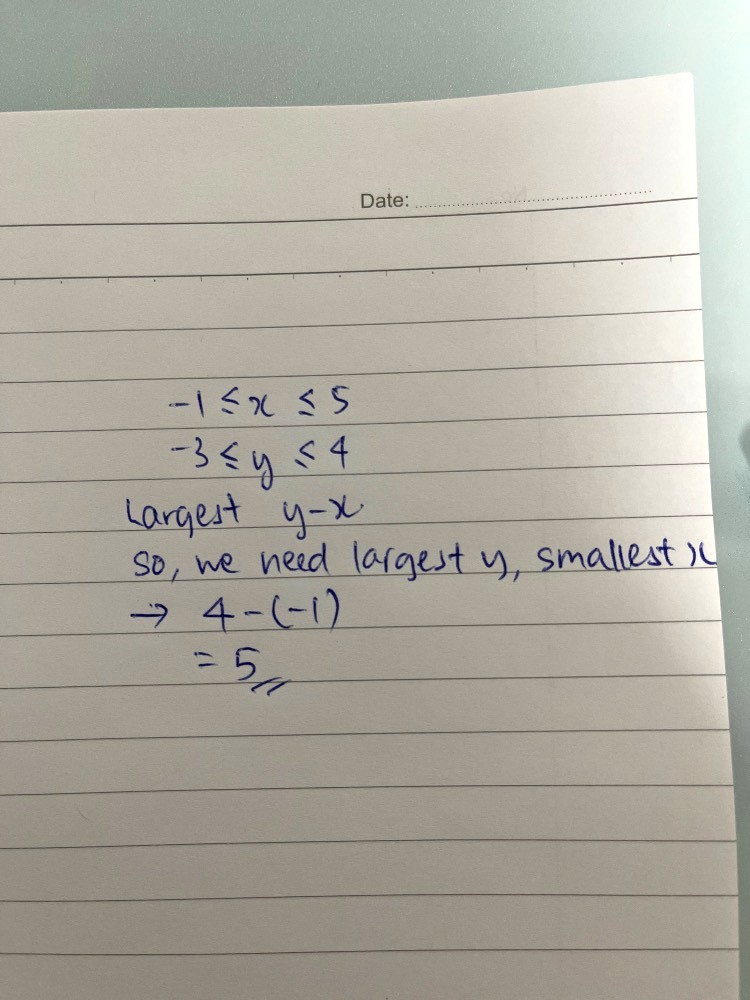

Hi ! Sorry for disturbing. May I ask why we have to find the smallest for x when the question mentions to find the largest possible value.

So because we need the largest value of the expression of (y-x) right, we will try to get a big number minus a small number, to give us a resulting ‘largest’ (y-x). I think you understand the need to take a largest value for y. Now let me give you an example on why we need the smallest value of x.
The largest value of y is 4.
If we take another value of x, lets say 3, which also satisfies the inequality, then
(y-x) = 4-3 =1. This gives a value of 1 which is smaller than 5(my original answer). And this 1 is not what we want, as is is not the ‘largest’ value of (y-x).
I hope this clears up the confusion.
I got it ! Thanks you so much

To put it in other words, we wish to "minimise losses" as far as possible by subtracting with the smallest number possible.

 360 Tutoring Program