Ask Singapore Homework?
Upload a photo of a Singapore homework and someone will email you the solution for free.

Question
secondary 4 | A Maths
One Answer Below
Anyone can contribute an answer, even non-tutors.

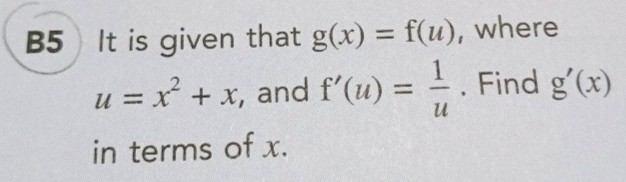
pls help with B5!
Date Posted: 5 years ago
Views: 237

A similar example to demonstrate the chain rule :
Let :
g(x) = x⁴, f(y) = y²
y(x) = x² → y'(x) = 2x
(Or you can write this in the equivalent form : y = x², dy/dx = 2x )
So f(y) = y² = (x²)² = x⁴ = g(x)
(We can also say show it like this :
fy(x) = f(x²) = (x²)² = x⁴ = g(x)
OR
f(y) = f(x²) = (x²)² = x⁴ = g(x)
Differentiate g(x) with respect to x,
g'(x) = 4x³ d(x)/dx = 4x³ (1) = 4x³
But since g(x) = f(y), we should get the same result of 4x³, when differentiating either one with respect to x.
Now as f(y) = y² , f'(y) = 2y d(y)/dy = 2y (1) = 2y
But we cannot say that g'(x) = f'(y) = 2y, since 2y = 2x² , which does not equal 4x³. This is differentiating with respect to y only.
If we are differentiating in terms of x, we realise that y is a function of x as well. So we have to differentiate y with respect to x also (i.e the term inside)
So g'(x)
= 4x³
= 2x² · 2x
= 2y · y'(x)
= f'(y) · y'(x)
(Or the equivalent : df/dy · dy/dx)
Likewise for this question :
Given :
g(x) = f(u)
u = x² + x → du/dx = 2x + 1
(or u'(x) = 2x + 1)
f'(u) = 1/u
So, g'(x)
= f'(u) u'(x) (or f'(u) du/dx)
= 1/u · (2x + 1)
= 1/(x² + x) · (2x + 1)
= (2x + 1) / (x² + x)
Given :
g(x) = f(u)
u = x² + x → du/dx = 2x + 1
(or u'(x) = 2x + 1)
f'(u) = 1/u
So, g'(x)
= f'(u) u'(x) (or f'(u) du/dx)
= 1/u · (2x + 1)
= 1/(x² + x) · (2x + 1)
= (2x + 1) / (x² + x)
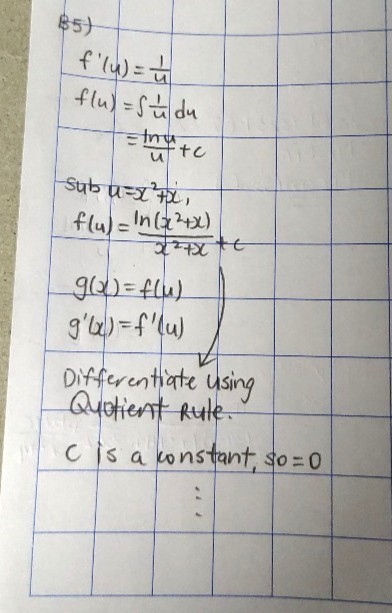
Alternative method :
f'(u) = 1/u
So,
f(u) = ∫ 1/u du
= ln u + c , where c is a constant
= ln (x² + x) + c
Since g(x) = f(u) , then g(x) = ln (x² + x) + c
g'(x) = d/dx ( ln(x² + x) + c)
= d/dx ln(x² + x) + d/dx (c)
= 1/(x² + x) · d/dx (x² + x) + 0 (c is a constant so differentiating it gives 0)
= 1/(x² + x) · (2x + 1)
= (2x + 1) / (x² + x)
See 1 Answer
done
{{ upvoteCount }} Upvotes
clear
{{ downvoteCount * -1 }} Downvotes

Hello there, this should be the solving steps. I have stopped at my last step. All you have to do right now is to complete the question by using quotient rule. Hope it helps
Date Posted:
5 years ago


 360 Tutoring Program