Ask Singapore Homework?
Upload a photo of a Singapore homework and someone will email you the solution for free.

Question
secondary 3 | A Maths
2 Answers Below
Anyone can contribute an answer, even non-tutors.

Anyone can help?
Date Posted: 5 years ago
Views: 343
See 2 Answers
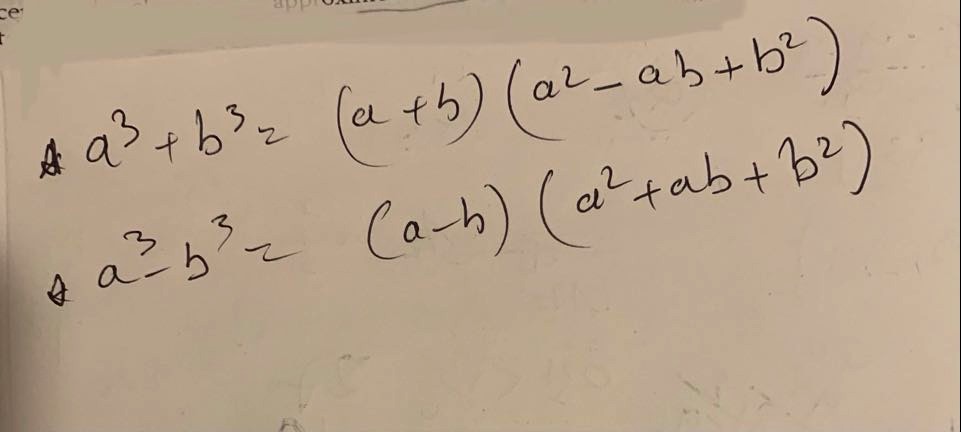

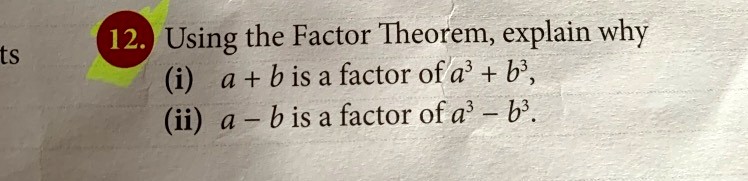
You will need to consider two cases : ① a is the variable ② b is the variable
i)
If a is the variable and b is a constant, let f(a) = a³ + b³
Now a + b = a - (-b)
When a³ + b³ is divided by (a - (-b)) ,
Remainder = f(-b) = (-b)³ + b³ = -b³ + b³ = 0
Since f(-b) = 0 , by the Factor Theorem, (a - (-b)) is a factor of f(a), which means (a + b) is a factor of a³ + b³
Similarly, If b is the variable and a is a constant, let f(b) = a³ + b³
Now a + b = b - (-a)
When a³ + b³ is divided by (b - (a)) ,
Remainder = f(-a) = a³ + (-a)³ = a³ - a³ = 0
Since f(-a) = 0 , by the Factor Theorem, (b - (-a)) is a factor of f(b), which means (a + b) is a factor of a³ + b³.
ii)
Likewise, If a is the variable and b is a constant, let f(a) = a³ - b³
When a³ - b³ is divided by (a - b) ,
Remainder = f(b) = b³ - b³ = 0
Since f(b) = 0 , by the Factor Theorem, (a - b) is a factor of f(a), which means (a - b) is a factor of a³ - b³.
Lastly, If b is the variable and a is a constant :
(a³ - b³)/(a - b) = -(b³ - a³)/-(b - a) = (b³ - a³)/(b - a)
Let f(b) = b³ - a³
When (b³ - a³) is divided by (b - a) ,
Remainder = f(a) = a³ - a³ = 0
Since f(a) = 0 , by the Factor Theorem, (b - a) is a factor of f(b), which means (b - a) is a factor of b³ - a³.
Then this implies that (a - b) is a factor of (a³ - b³) since (a³ - b³)/(a - b) = (b³ - a³)/(b - a)
Eg. 6 ÷ 2 = 6/2 = 3 , so 2 is a factor of 6.
But since 6/2 = -6/-2, then -6/-2 also = 3 , so -2 is a factor of -6.

The factor theorem can also be used this way :
If f(x) is divided by (a - x),
Let f(x) = (a - x)Q(x) + remainder
Sub x = a,
f(a) = (a - a)Q(a) + remainder
f(a) = remainder
if f(a) = 0, remainder = 0 . Then (a - x) is a factor of f(x)
So the factor doesn't strictly have to be in the form (x - a)
So in ii),
When b is the variable and a is the constant, we don't have to consider (b³ - a³)/(b - a) and we can do (a³ - b³)/(a - b) immediately.
Let f(b) = a³ - b³. When a³ - b³ is divided by (a - b),
Remainder = f(a) = a³ - a³ = 0
So (a - b) is a factor.


 360 Tutoring Program