Ask Singapore Homework?
Upload a photo of a Singapore homework and someone will email you the solution for free.

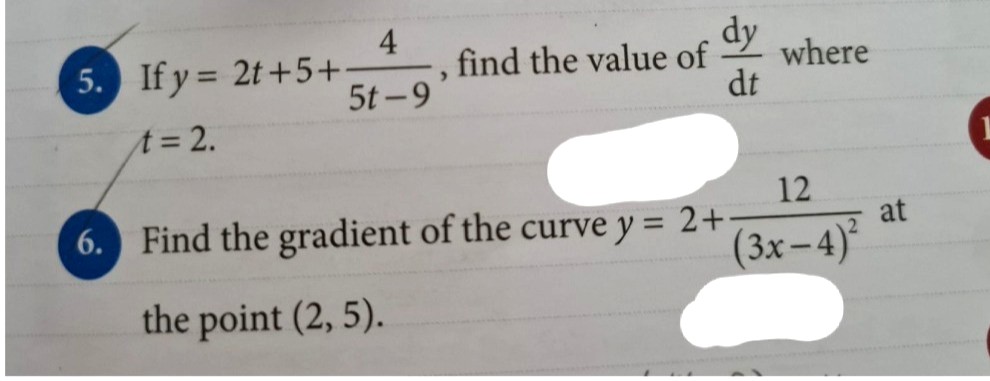
Question
secondary 4 | A Maths
One Answer Below
Anyone can contribute an answer, even non-tutors.

need help with these qns, pls explain too
Date Posted: 5 years ago
Views: 216

Basically we differentiate an expression and then sub the value in.
Note that the order matters. If you sub in first and then differentiate, you would always get a value of zero.
Note that the order matters. If you sub in first and then differentiate, you would always get a value of zero.
i tried a few times and my answers are all positive and also wrong... the tutor also got the wrong answer
I do for you now, on text
y = 2t + 5 + [4 / (5t - 9)]
y = 2t + 5 + 4 (5t - 9)^-1
Differentiating, dy/dt
= 2 + 0 + (-1) (4) (5t - 9)^-2 times d/dt (5t - 9)
= 2 - 4 (5t - 9)^-2 times 5
= 2 - [20 / (5t - 9)^2]
We sub in the value of t for our answer.
When t = 2, dy/dt
= 2 - 20 / 1^2
= -18
y = 2t + 5 + 4 (5t - 9)^-1
Differentiating, dy/dt
= 2 + 0 + (-1) (4) (5t - 9)^-2 times d/dt (5t - 9)
= 2 - 4 (5t - 9)^-2 times 5
= 2 - [20 / (5t - 9)^2]
We sub in the value of t for our answer.
When t = 2, dy/dt
= 2 - 20 / 1^2
= -18
y = 2 + 12 / (3x - 4)^2
y = 2 + 12 (3x - 4)^-2
Differentiating, dy/dx
= 0 + (-2) (12) (3x - 4)^-3 times d/dx (3x - 4)
= -24 (3x - 4)^-3 times 3
= -72 / (3x - 4)^3
At (2, 5), x = 2 and the value of dy/dx
= -72 / 2^3
= -9
y = 2 + 12 (3x - 4)^-2
Differentiating, dy/dx
= 0 + (-2) (12) (3x - 4)^-3 times d/dx (3x - 4)
= -24 (3x - 4)^-3 times 3
= -72 / (3x - 4)^3
At (2, 5), x = 2 and the value of dy/dx
= -72 / 2^3
= -9

Thank you for pointing out my mistakes, Eric! My bad, I'm sorry Lock B.
its ok, thanks for taking your time to help me with this qn :)
thx Mr Eric :)
the chain rule only applies for bracketed ones, for the numbers with no bracket, just apply the normal differentiation?
the chain rule only applies for bracketed ones, for the numbers with no bracket, just apply the normal differentiation?
Yes
See 1 Answer
.


 360 Tutoring Program