Ask Singapore Homework?
Upload a photo of a Singapore homework and someone will email you the solution for free.

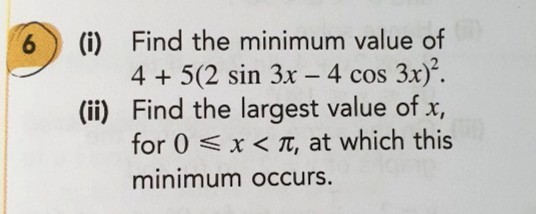
Question
secondary 4 | A Maths
One Answer Below
Anyone can contribute an answer, even non-tutors.

pls help. need it by today
Date Posted: 5 years ago
Views: 469

Use the R-formula to convert the term inside the brackets into a single trigonometric term first.
a sin θ - b cosθ = R sin (θ - α), whereby :
R = √(a² + b²)
α = tan-¹ (b/a)
So, for 2 sin 3x - 4 cos 3x,
R = √(2² + 4²) = √20
α = tan-¹ (4/2) = tan-¹(2)
❲You can find the approximate value of tan-¹(2) ≈ 1.107 rad or 63.43° but I prefer to leave it in exact form.❳
So , 4 + 5(2 sin 3x - 4 cos 3x)²
= 4 + 5(√20 sin (3x - tan-¹(2) )²
= 4 + 5(20 sin² (3x - tan-¹(2) )
= 4 + 100 sin² (3x - tan-¹(2) )
Now recall that -1 ≤ sin A ≤ 1 for all real values of A
So if we were to square sin A, all the negative values of sin A become positive. Since 1² = 1 and (-1)² = 1, the max value of sin² A = 1 for all real values of A.
Then, the minimum value of sin² A would be 0 since the square of 0 is still 0.
So, 0 ≤ sin² A ≤ 1
Likewise,
0 ≤ sin² (3x - tan-¹ (2) ) ≤ 1
Then 0 ≤ 100 sin² (3x - tan-¹ (2) ) ≤ 100
4 ≤ 4 + 100 sin² (3x - tan-¹ (2) ) ≤ 104
4 ≤ 4 + 5(2 sin 3x - 4 cos 3x)² ≤ 104
Minimum value is 4.
At the minimum value,
sin² (3x - tan-¹ (2) ) = 0
⇒sin (3x - tan-¹ (2) ) = 0
Basic angle = sin-¹ (0) = 0
Now, integer multiples of π always give 0 when we take the sin of them , as the opposite side has magnitude of 0 and sin of an angle = opposite/hypotenuse .
i.e sin (-π) = 0, sin 0 = 0, sin π = 0, sin 2π = 0, sin 3π = 0, ...
Next, the range given is 0 ≤ x < π
Then, 0 ≤ 3x < 3π
-tan-¹(2) ≤ 3x - tan-¹(2) < 3π - tan-¹(2)
So, the values of 3x - tan-¹(2) that satisfies the range are:
3x - tan-¹(2) = 0, π, 2π
3x = tan-¹(2), π + tan-¹(2), 2π + tan-¹(2)
x = ⅓tan-¹(2), ⅓(π + tan-¹(2)) ⅓(2π + tan-¹(2))
x ≈ 0.3690 rad, 1.416 rad, 2.463 rad
Greatest value of x = 2.46 rad (3s.f)
Alternative to ii)
Once we have established 4 + 5(2 sin 3x - 4 cos 3x)² = 4 at the minimum,
Then 5(2sin 3x - 4 cos 3x)² = 0
(2 sin 3x - 4 cos 3x)² = 0
2 sin 3x - 4 cos 3x = 0
2 sin 3x = 4 cos 3x
sin 3x / cos 3x = 2
tan 3x = 2
(Positive, so 3x is in the 1st or 3rd quadrant)
Basic angle = tan-¹(2) ≈ 1.107 rad
Given that 0 ≤ x < π, then 0 ≤ 3x < 3π
So 3x ≈ 1.107 rad, (π + 1.107) rad, 2π + 1.107 rad
x ≈ 0.369 rad, 1.416 rad, 2.463 rad
Maximum value of x = 2.46 rad (3s.f)
See 1 Answer
Answered in comments section.


 360 Tutoring Program