Ask Singapore Homework?
Upload a photo of a Singapore homework and someone will email you the solution for free.

Question
secondary 4 | A Maths
4 Answers Below
Anyone can contribute an answer, even non-tutors.

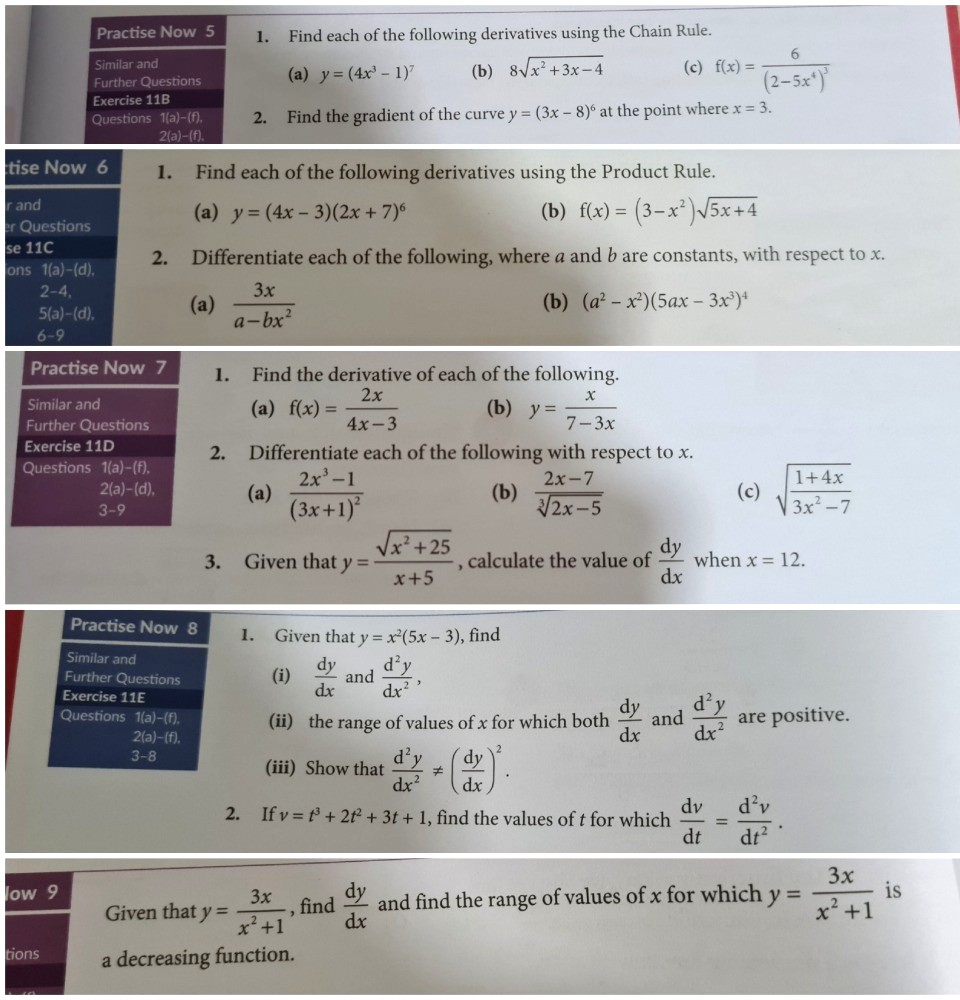
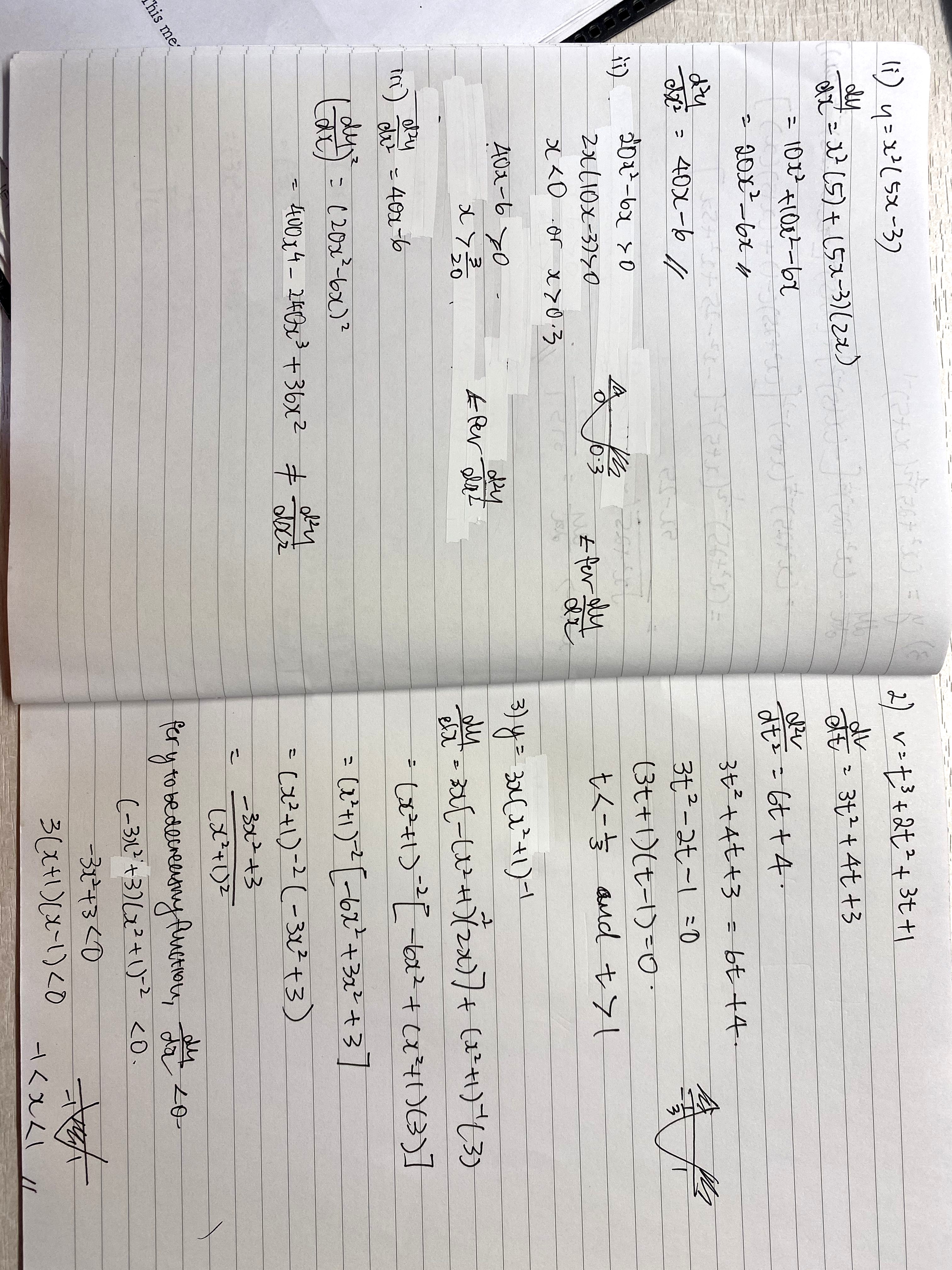
need help with these qns, pls explain too
Date Posted: 5 years ago
Views: 530

I saw that a different tutor has done the question already for now so I won’t look through them.
i dont really know how to use the rules tho
The rules get harder as you progress on. You need me to help a little later? I can spare the time later.
yep, i read the textbook and saw the workings but i dont really understand what is going on...
also need help with higher derivatives, increasing and decreasing functions other than the rules
also need help with higher derivatives, increasing and decreasing functions other than the rules
Let's look at the first example on Practise Now 5.
y = (4x³ - 1)^7
Now, this looks very similar to y = x^7, except that instead of x, its 4x³ - 1. Because of this difference, the chain rule comes in. In short, we need to do the additional step of multiplying the result by the differential of this expression inside the brackets (i.e. differentiate the 4x³ - 1 to become 12x²).
dy/dx
= 7 (4x³ - 1)^6 times d/dx (4x³ - 1)
= 7 (4x³ - 1)^6 times 12x²
= 84x² (4x³ - 1)^6
The product rule in Practise Now 6 is basically a rule we use when we differentiate the product of two terms. Remember that at the start I mentioned that for a product of two terms, we cannot differentiate each term separately follow by multiply the result? This rule then kicks in,
Suppose y = ab where a and b are functions of x. We call a the first term and b the second term.
The expression for dy/dx goes like this.
keep first times differentiate second + keep second times differentiate first
For Q1a,
y = (4x - 3) (2x + 7)^6
The "first" is (4x - 3).
The "second" is "(2x + 7)^6.
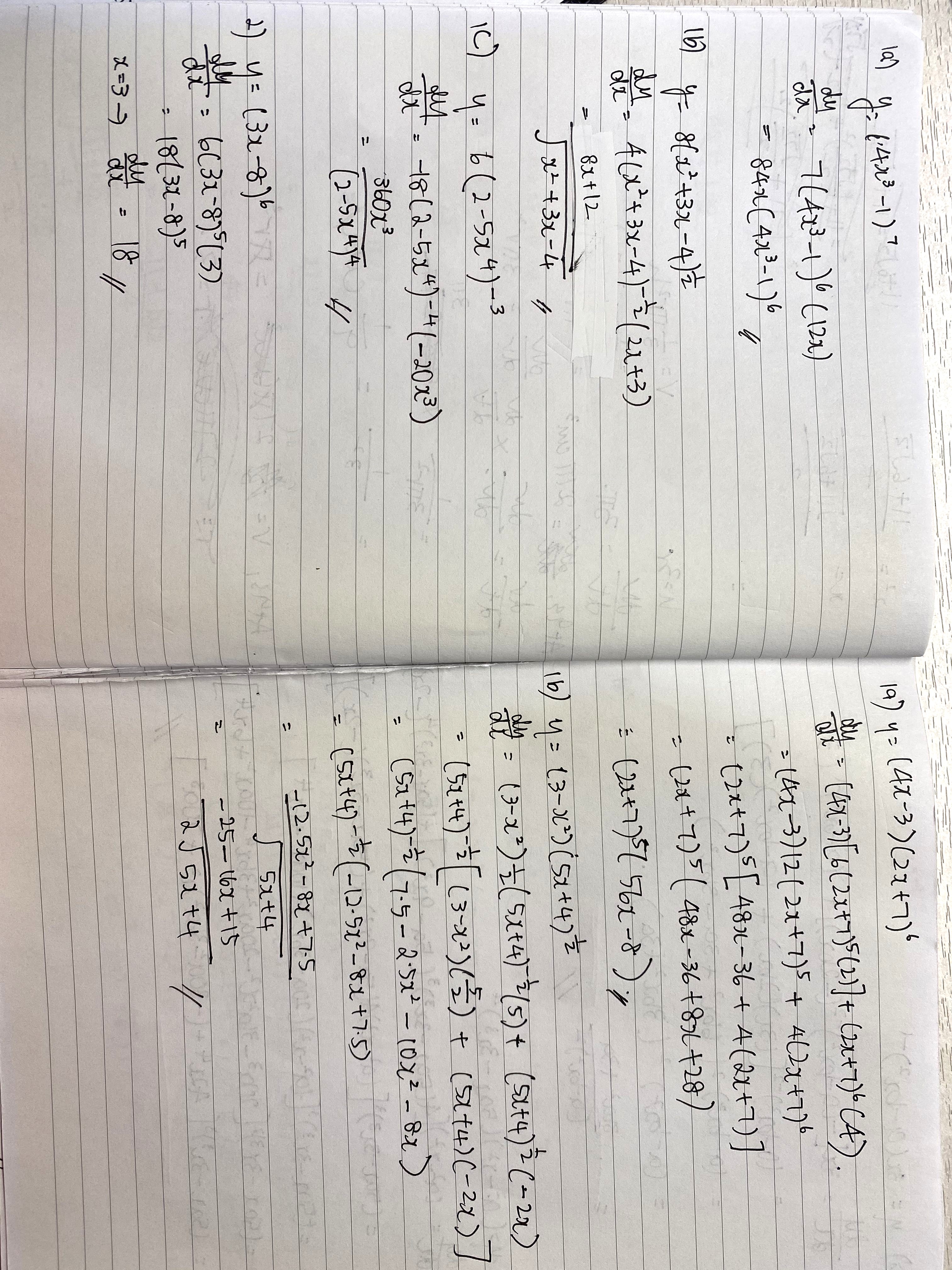
The formula to use is "keep first times differentiate second + keep second times differentiate first". Chain rule continues to apply later on when we differentiate expressions. The tutor has done this for you.
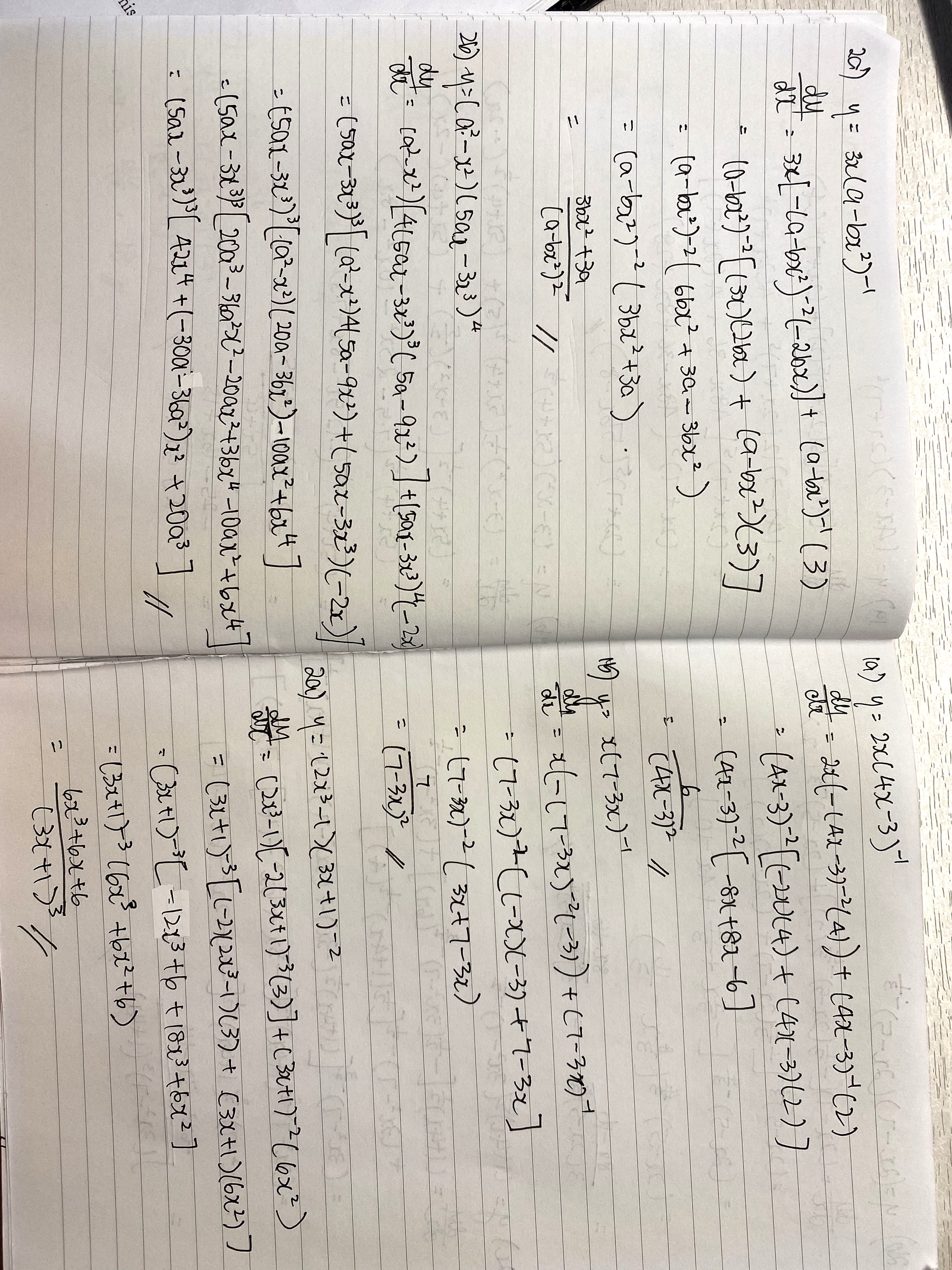
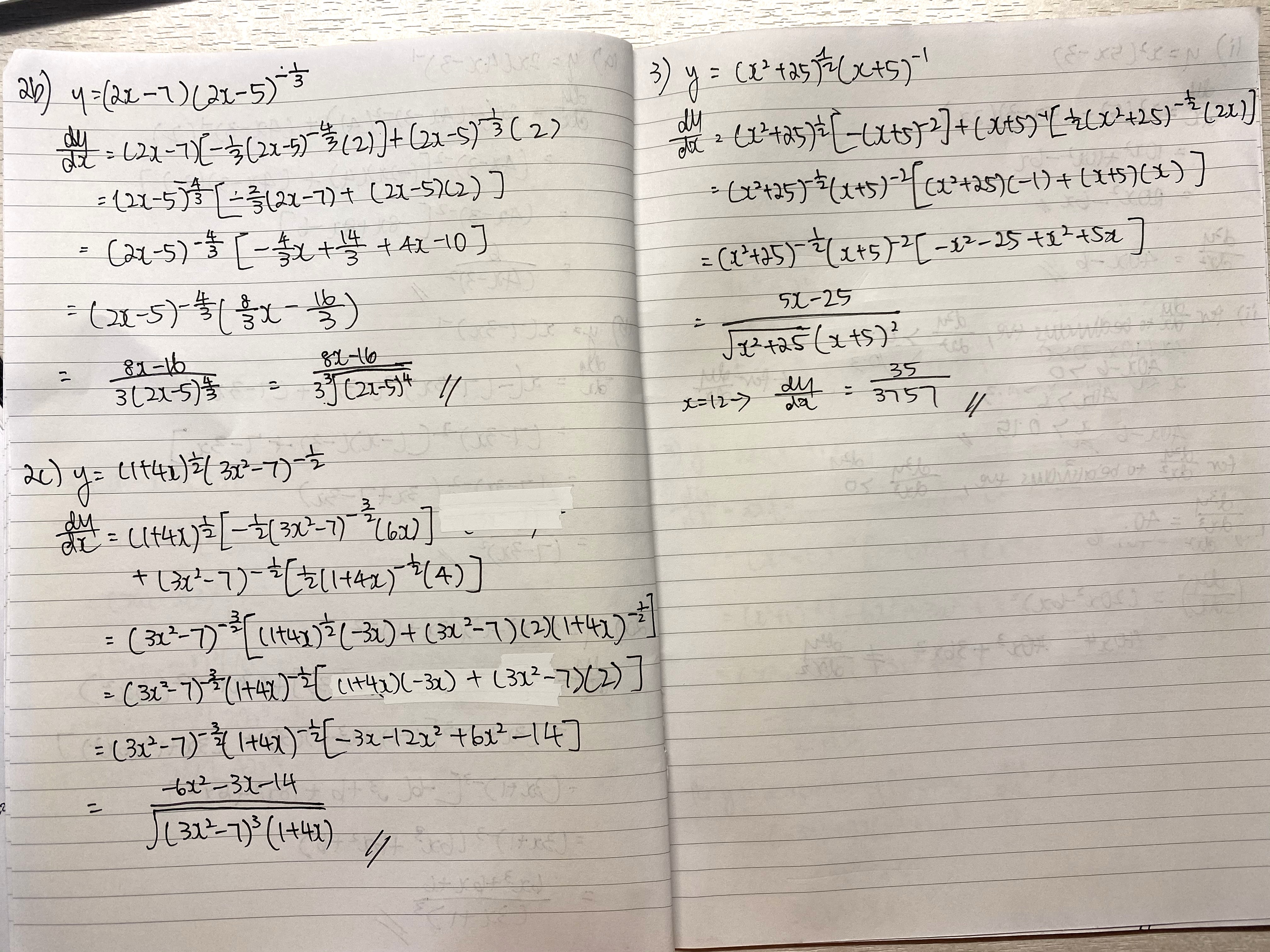
For Practise Now 7, the Quotient Rule, as its name suggests, is for division. Similar to the Product Rule, it has a formula as well, given as
keep second times differentiate first - keep first times differentiate second, whole thing divided by second²
Chain rule continues to apply as well.
also need help with higher derivatives, increasing and decreasing functions other than the rules
Higher derivatives are basically differentiating expressions which are already differentiated before.
For Practise Now 8 Q1,
y = 5x³ - 3x²
Differentiating,
dy/dx = 15x² - 6x
Differentiating again,
d²y/dx² = 30x - 6
The notation for differentiation a second time is d²y/dx². The notation for differentiation yet a third time is d³y/dx³. Higher ones also exist but I won't discuss them here.
Increasing functions are basically functions which increase in value as x increases. Think of y = x + 1. The value of y always increases as x increases, so the graph heads upwards with a positive gradient. This indicates that dy/dx > 0. For all increasing functions, dy/dx > 0 because the graph has to move diagonally upwards.
Decreasing functions are similar and dy/dx < 0.
for practice now 5 we can just leave (4x^3-1) alone?
Well, not exactly leave it alone. For the “bring down power and reduce power by 1” component, yes you can. But after that, the chain rule states that you must multiply the product by the differential of the 4x3 - 1.
i still cant do 1c from practice now 5 and practice now 6 Q2b
i dont understand how it works although i looked at the answer given
i dont understand how it works although i looked at the answer given
why can the power - 1/2 be factorised from the power 1/2 tho (saw it from the tutor's ans, practice now 6 qn 1b - 3rd column)
Practise Now 5
Q1c
f(x) = 6 times (2 - 5x4)^-3
Differentiating,
f'(x)
= 6 times -3 times (2 - 5x4)^-4 times d/dx (2 - 5x4)
= -18 times (2 - 5x4)^-4 times (-20x³)
= 360x³divided by (2 - 5x4)^4
Q1c
f(x) = 6 times (2 - 5x4)^-3
Differentiating,
f'(x)
= 6 times -3 times (2 - 5x4)^-4 times d/dx (2 - 5x4)
= -18 times (2 - 5x4)^-4 times (-20x³)
= 360x³divided by (2 - 5x4)^4
Practise Now 6 Q2b is not something you should be seeing in the exams.
"first" = a² - x²
"second" = (5ax - 3x³)^4
By the product rule, d/dx (the whole line)
= keep first differentiate second + keep second differentiate first
= (a² - x²) times d/dx (5ax - 3x³)^4 + (5ax - 3x³)^4 times d/dx (a² - x²)
= (a² - x²) times (4) (5ax - 3x³)^3 times d/dx (5ax - 3x³) + (5ax - 3x³)^4 times (-2x)
and then we simplify thereafter
why can the power - 1/2 be factorised from the power 1/2 tho (saw it from the tutor's ans, practice now 6 qn 1b - 3rd column)
---------------------------------------------
Whenever we differentiate using the product rule, we usually face an expression which is of exactly one power higher than the other. This because in the expression
keep second differentiate first + keep first differentiate second,
the "differentiate first" and the "keep first" are separated by exactly one power (one is differentiated, the other is not).
Majority of the time you should notice this happening as you do the questions.
thx :) btw can you help me with set language and notation when you are free? i find the chapter confusing...
I have seen it, but I am outside currently
ok, can be later as well... dont really understand anything about set language and notations
See 4 Answers



 360 Tutoring Program